Museum emails worth copying from real institutions
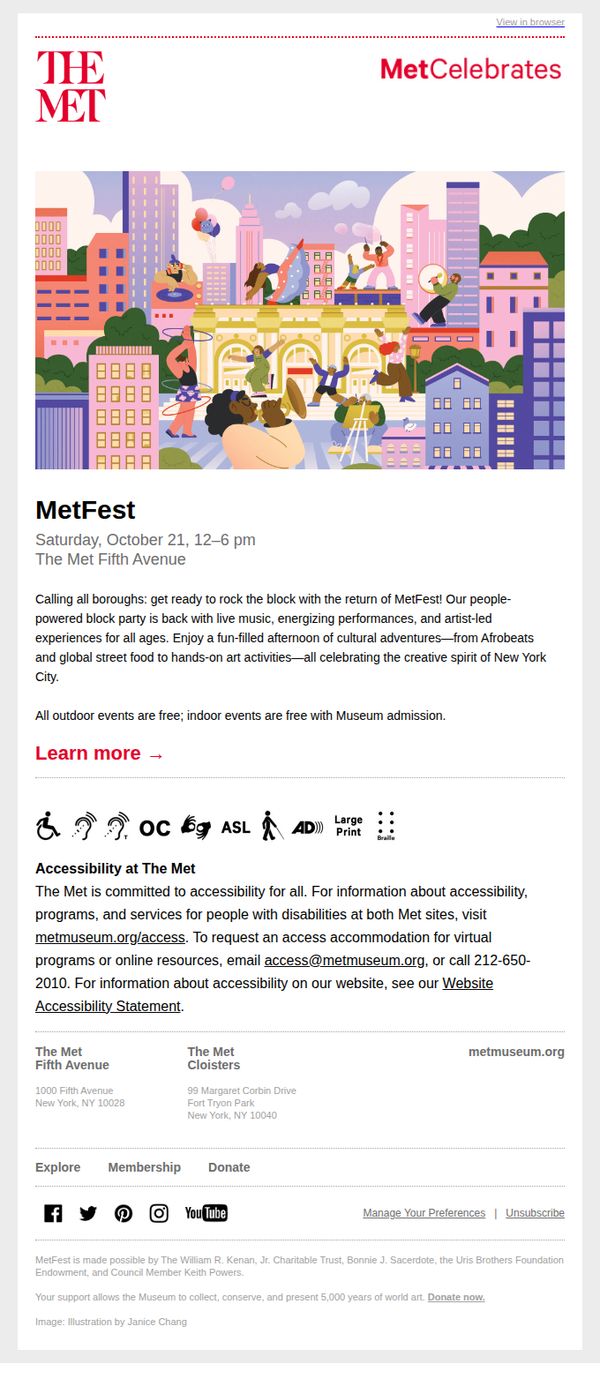


1. The Metropolitan Museum of Art: Save the date! MetFest is back Saturday, October 21
Objective
The email aims to generate excitement and drive attendance for MetFest, a free community block party celebrating New York City’s creative spirit through live music, performances, and hands-on art activities. It emphasizes accessibility and inclusivity to encourage broad public participation.
Why this works
The email brilliantly frames MetFest as a neighborhood block party rather than a museum event, making it feel inclusive, approachable, and rooted in local culture, a smart emotional hook for community engagement.
How to implement
By clearly stating that all outdoor events are free and indoor events require only museum admission, the email removes financial friction and positions the event as accessible to all income levels, which boosts conversion potential.
Pro Tip
Add a visual countdown timer or 'Only X days left!' banner near the CTA to create urgency and nudge procrastinators to act before the event date. • Include a small map or directional graphic near the venue address to reduce friction for first-time visitors unfamiliar with The Met’s location on Fifth Avenue.
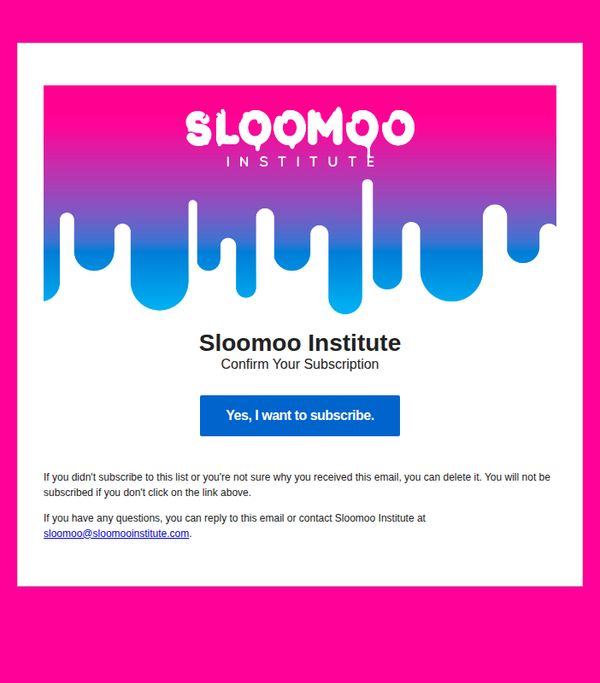
2. Sloomoo Institute: Confirm Your Subscription
Objective
This email aims to confirm a new subscriber’s intent to join the Sloomoo Institute mailing list by prompting them to actively opt in, ensuring list hygiene and compliance while reinforcing brand identity through bold visual design.
Why this works
The email leverages a high-contrast, playful gradient header with dripping slime visuals to instantly communicate brand personality while anchoring the subscriber’s attention on the core action, confirmation, without visual clutter.
How to implement
By placing the primary CTA button front and center with clear, affirmative language, the email reduces friction and decision fatigue, making it effortless for users to complete the subscription step with confidence.
Pro Tip
Add a brief value proposition or teaser about what subscribers will receive (e.g., 'Get exclusive slime recipes and early access to workshops') to increase conversion by answering 'What’s in it for me?' before the CTA. • Include a secondary, less prominent CTA or link labeled 'No thanks, I’ll unsubscribe' to reduce friction for accidental sign-ups and improve user experience without compromising conversion rates.
3. The Metropolitan Museum of Art: Celebrate Black History Month and Lunar New Year at The Met 🎉
Objective
This email aims to drive family attendance to The Met’s culturally themed events during Black History Month and Lunar New Year by highlighting free, hands-on activities that blend art, education, and celebration for all ages. It also encourages ticket purchases for the exclusive 'Seeing Stars' evening event while reinforcing membership and visit planning.
Why this works
The email brilliantly ties cultural celebrations to hands-on, intergenerational learning by framing Lunar New Year and Black History Month not as passive observances but as active, art-driven experiences that invite families to create, explore, and connect through the museum’s collection.
How to implement
By clearly labeling each event with its cultural context and target age group, the campaign removes decision fatigue for parents and caregivers, making it easy to identify which activities are relevant, free, and suitable for their children’s developmental stage and interests.
Pro Tip
The primary CTA 'Buy your tickets now' is buried near the bottom and visually underwhelming; it should be moved above the fold, styled with higher contrast and urgency (e.g., 'Limited Tickets Left for Seeing Stars!'), and repeated after each event description to capture intent at the moment of interest. • The email lacks a visual or textual cue to help users quickly distinguish between free and ticketed events; adding a small icon or color-coded tag (e.g., 'FREE' in green, 'TICKETS REQUIRED' in red) next to each event title would improve scanning efficiency and reduce confusion.
4. Whitney Museum of American Art: Opening Soon! Experience the Art of Henry Taylor, Ruth Asawa, and Harry Smith
Objective
This email aims to drive attendance and membership by announcing the opening of two major fall exhibitions while promoting a community festival and educational programs. It seeks to position the Whitney as a vibrant cultural hub offering diverse, accessible experiences for all ages.
Why this works
The email masterfully ties together multiple events under a seasonal theme, fall, creating a sense of urgency and cultural momentum that encourages immediate action rather than passive browsing.
How to implement
By spotlighting both high-profile exhibitions and community-driven events like the West Side Fest, the campaign balances prestige with accessibility, appealing to both art connoisseurs and local families.
Pro Tip
Add a countdown timer near the 'Book Tickets' CTA to emphasize the limited-time nature of the Member Previews and West Side Fest, increasing urgency without cluttering the layout. • Include a small map or neighborhood graphic next to the 'Whitney Neighborhood Arts Walk' section to visually anchor the event’s location and encourage local attendance through spatial familiarity.
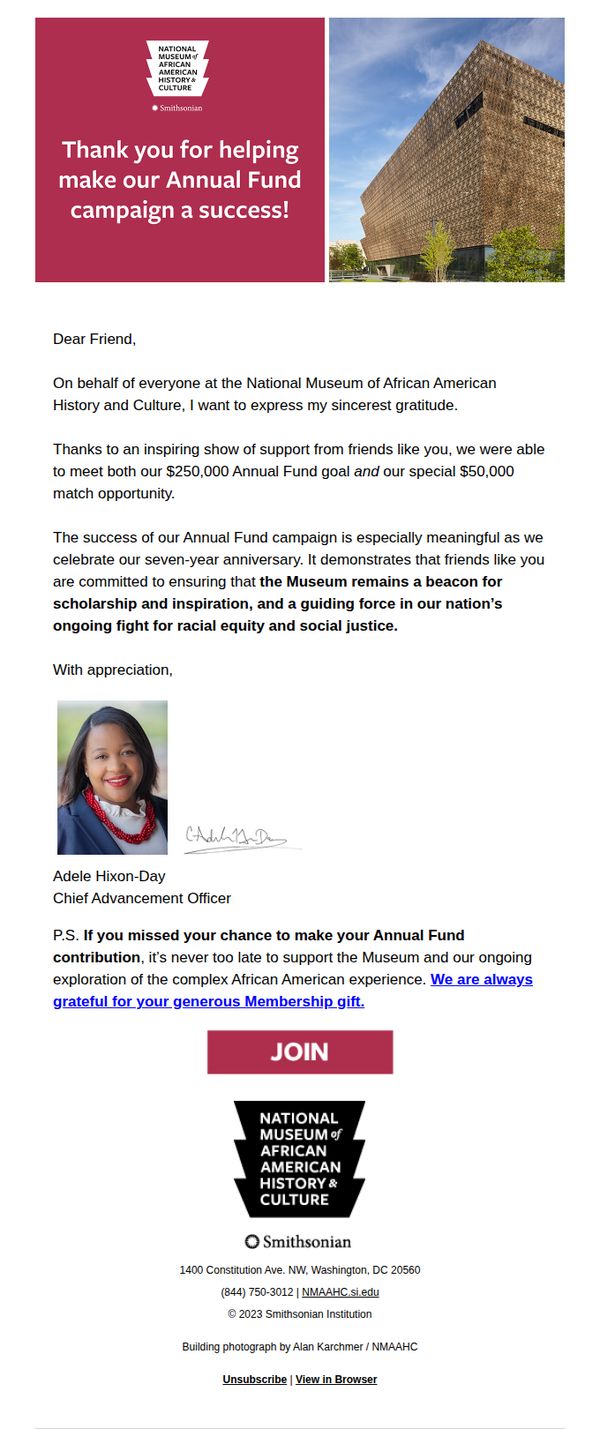
5. Smithsonian : Your support made all the difference
Objective
This email aims to express heartfelt gratitude to donors for helping the National Museum of African American History and Culture meet its Annual Fund goal and match opportunity, while gently encouraging late contributors to still join in support of the museum’s mission.
Why this works
The email masterfully blends emotional storytelling with tangible impact by highlighting both the financial milestone achieved and the deeper mission of racial equity, making donors feel personally connected to the museum’s legacy and future.
How to implement
By anchoring the message in a seven-year anniversary, the campaign leverages milestone psychology to elevate donor contributions from transactional to commemorative, reinforcing that their support is part of a historic, ongoing journey rather than a one-time event.
Pro Tip
Add a visual progress bar or counter near the CTA to show how close the campaign is to a new stretch goal, creating urgency and encouraging late donors to push the total even higher. • Include a short testimonial or quote from a scholar or community member impacted by the museum’s work to humanize the mission beyond financials and deepen emotional resonance.
6. The Metropolitan Museum of Art: Making Waves

Objective
This email aims to drive engagement and sales by showcasing a curated collection of sea-inspired products across multiple categories, encouraging recipients to explore and purchase items that reflect aquatic artistry while supporting The Met’s mission.
Why this works
The email masterfully ties product aesthetics to a thematic narrative, using oceanic imagery and color palettes to create an immersive, story-driven shopping experience that feels curated rather than transactional.
How to implement
By organizing products into clearly labeled category grids with bold, consistent CTAs, the email reduces decision fatigue and guides users intuitively through each product type without overwhelming them with choice.
Pro Tip
Add a subtle countdown timer or limited-edition badge near the 'New Waves' headline to create urgency around the aquatic collection, especially since the theme suggests seasonal or tide-inspired exclusivity. • Include a short customer testimonial or curator quote beneath the hero image to add social proof and authority, reinforcing that these designs are not just trendy but culturally resonant and expertly selected.
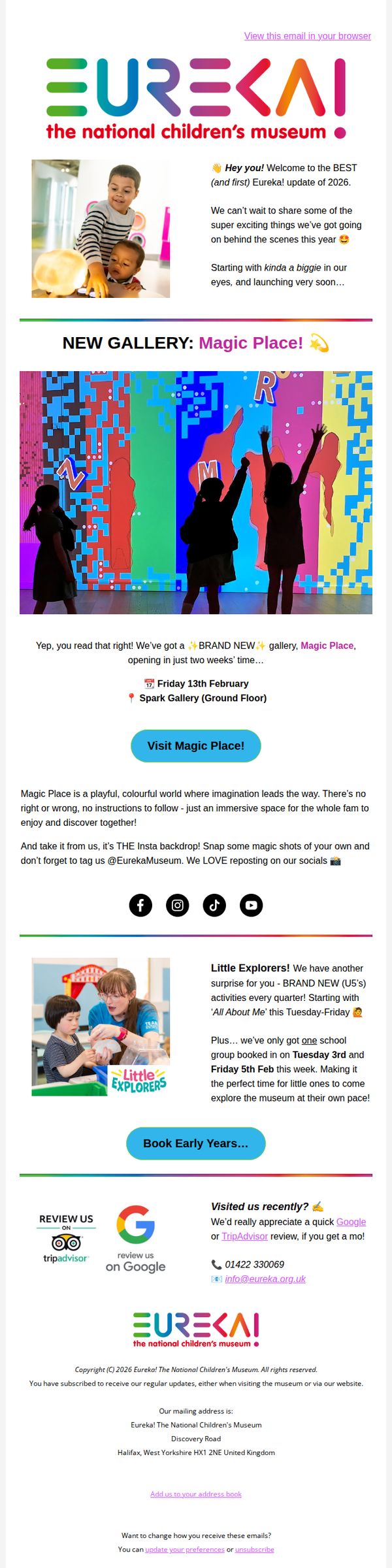
7. Eureka The National Children's Museum : NEW GALLERY and Early Years Updates...
Objective
This email aims to excite families and educators about Eureka!'s upcoming Magic Place gallery launch while promoting early years programming, encouraging immediate visits and social sharing to drive foot traffic and community engagement.
Why this works
The email brilliantly frames the new Magic Place gallery as an immersive, rule-free zone where imagination leads, a powerful emotional hook that positions the museum as a sanctuary for unstructured, joyful family discovery rather than just another exhibit.
How to implement
By teasing the gallery launch with a specific date and location while adding social proof through the 'Insta backdrop' callout, the campaign turns visitors into brand ambassadors, leveraging user-generated content to amplify reach without additional ad spend.
Pro Tip
Add a countdown timer or 'Only X spots left!' indicator near the 'Visit Magic Place!' CTA to create urgency and nudge immediate action, especially since the launch is just two weeks away. • Include a brief bullet list of what families can expect inside Magic Place, e.g., 'Touchable walls, sound-reactive floors, photo zones', to reduce uncertainty and increase perceived value before the visit.
8. MoMA: Have you seen this chair?

Objective
To celebrate the legacy of Charles and Ray Eames by highlighting their iconic Lounge Chair, educating subscribers on their design philosophy, and driving engagement through shopping, event attendance, and museum visits.
Why this works
The email brilliantly frames the Eames Lounge Chair not just as furniture but as a cultural artifact, using storytelling to connect its 1956 origins with timeless design principles that still resonate today.
How to implement
By weaving in both educational content and actionable CTAs, from shopping exclusives to family workshops, the campaign balances inspiration with conversion, making it feel enriching rather than promotional.
Pro Tip
The primary CTA 'Read more' is underwhelming for a campaign promoting both products and events; it should be context-specific, such as 'Shop the Collection' or 'Reserve Your Workshop Spot,' to match user intent. • The email lacks a visual hierarchy guiding users from the hero image to the most urgent action, adding a subtle arrow, bolded CTA button, or countdown timer for the 'Last chance!' exhibit would improve conversion flow.
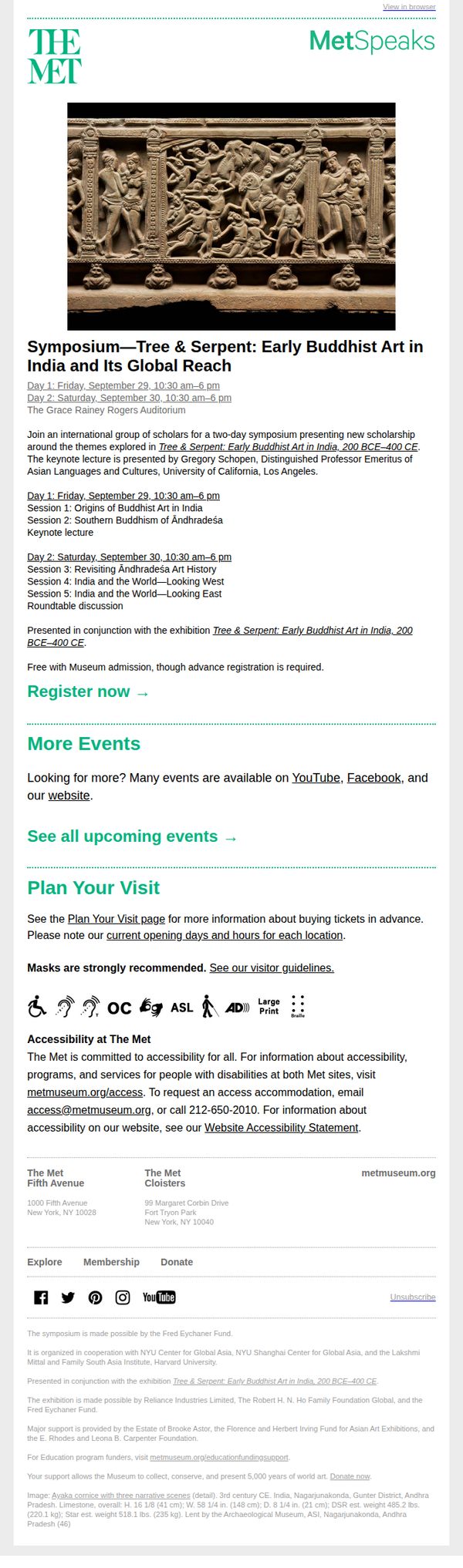
9. The Metropolitan Museum of Art: Symposium—Tree & Serpent: Early Buddhist Art in India, 200 BCE–400 CE
Objective
This email aims to drive registrations for a two-day academic symposium on early Buddhist art in India, aligning it with a current museum exhibition to deepen visitor engagement and position The Met as a scholarly cultural leader.
Why this works
The email brilliantly anchors the symposium to a physical exhibition, creating a dual-value proposition that transforms an academic event into a must-attend cultural experience for both scholars and art lovers.
How to implement
By listing each session with clear titles and dates, the email reduces cognitive load for busy professionals, making it easy to evaluate relevance and commit without needing to click through multiple pages.
Pro Tip
Add a visual countdown timer near the CTA to create urgency, since the symposium has a fixed date and advance registration is required, this would nudge procrastinators to act immediately. • Include a short testimonial or quote from a past symposium attendee or scholar to build social proof, especially since the audience is academic and values peer validation before committing time.
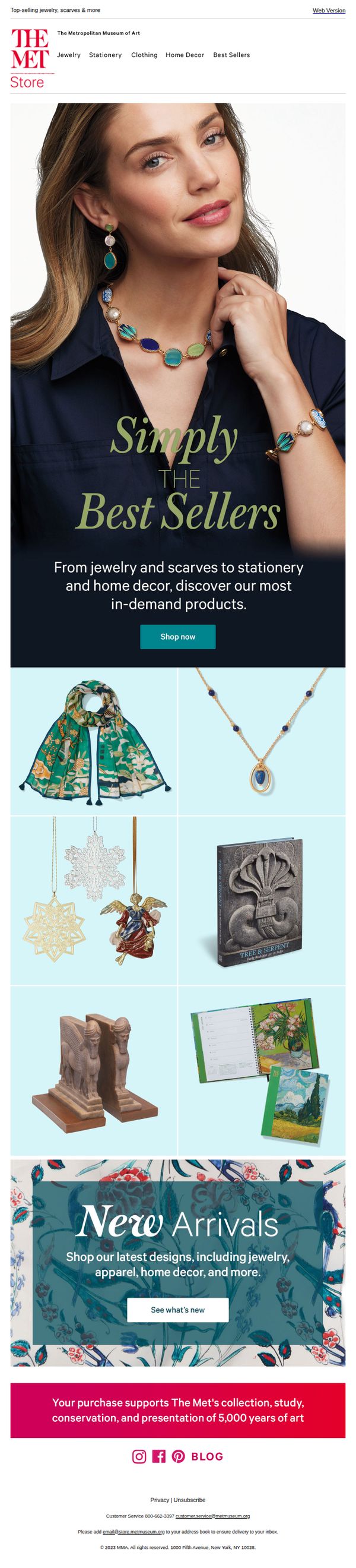
10. The Metropolitan Museum of Art: Our Most In-Demand Items
Objective
This email aims to drive sales by showcasing The Met Store’s top-selling and newly arrived products, encouraging recipients to explore and purchase items that support the museum’s mission while appealing to art lovers and gift shoppers.
Why this works
The email leverages emotional resonance by tying product purchases directly to the museum’s cultural mission, transforming a simple transaction into a meaningful act of support for art conservation and education.
How to implement
By featuring a visually rich product grid with diverse categories, from jewelry to home decor, the email caters to varied tastes while maintaining a cohesive aesthetic that reflects The Met’s artistic heritage.
Pro Tip
Add a subtle countdown timer or limited-availability tag near the 'Shop now' CTA to create urgency, especially since bestsellers may sell out quickly and this could nudge hesitant buyers to act faster. • Include a short testimonial or customer review snippet near the product grid to build social proof, especially for high-ticket items like jewelry or decorative objects, which benefit from peer validation.