AI with Allie email gallery from real brands





1. The 6 ways to work with AI agents
Objective
This email aims to educate professionals on six practical methods for delegating tasks to AI agents while positioning the sender as an authority in AI workflow design, ultimately driving enrollment in the AI-First Academy through a time-sensitive Cyber Week offer.
Why this works
The email brilliantly structures complex AI workflow strategies into six digestible, named methods, each with real-world examples and tool references, making advanced automation feel approachable and immediately actionable for non-technical professionals.
How to implement
By embedding a free, customizable agent protocol template within the educational content, the campaign transforms passive readers into active participants, creating intrinsic value that primes them for the paid offer without feeling salesy or premature.
Pro Tip
Add a visual progress bar or checklist next to the six methods to help readers track which sections they’ve consumed, increasing engagement and reducing drop-off before reaching the CTA. • Include a short testimonial or case study snippet after Method 6 showing how a real team implemented the protocol template, this would strengthen social proof and reduce perceived risk before the sales pitch.
2. My 2026 AI predictions (and the three things you NEED to focus on)
Objective
This email aims to position Allie as a forward-thinking AI strategist by sharing bold, data-backed predictions for 2026 while guiding readers toward actionable focus areas. It also seeks to drive enrollment in The AI-First Academy by framing AI adoption as urgent and transformative for career and business success.
Why this works
The email masterfully blends provocative predictions with concrete examples, like Claude Code’s enterprise impact or voice AI’s rise, making abstract AI trends feel tangible, urgent, and relevant to the reader’s daily workflow and strategic planning.
How to implement
By anchoring each prediction in credible sources, Fortune, Anthropic, OpenAI, and even internal metrics, the email builds authority without sounding self-promotional, turning speculative forecasts into trusted guidance that readers are more likely to act upon.
Pro Tip
Add a subtle countdown timer or progress bar near the CTA to create scarcity around academy enrollment, especially since the content emphasizes urgency around 2026 AI shifts, this would visually reinforce the 'act now' message without disrupting flow. • Include a short bulleted list of 'What You’ll Learn' directly under the CTA button to reduce friction, many readers may hesitate because they’re unsure what value the academy delivers beyond general AI prep, so clarifying outcomes upfront can boost conversion.
3. I need you to learn Claude Code immediately - here’s how.
Objective
This email aims to urgently convince professionals to adopt Claude Code by highlighting its transformative impact on productivity and workflow, while driving immediate action through free tutorials and a paid course enrollment. It positions Claude Code as essential for career and business relevance in 2026.
Why this works
The email brilliantly frames Claude Code not as a coding tool but as a conversational AI agent that eliminates the intimidation of the blank page, making it accessible even to non-engineers by positioning it as a thinking partner rather than a technical interface.
How to implement
By embedding real user testimonials and viral social proof, like the $27k subscription cancellation hack, the campaign transforms abstract AI capabilities into tangible, emotionally resonant outcomes that trigger FOMO and validate the tool’s real-world business impact beyond theoretical use cases.
Pro Tip
The CTA 'Join AI-First Academy →' appears too late and lacks visual hierarchy; it should be repeated above the fold with stronger urgency language like 'Start Your 2026 AI Transformation Now, Free Tutorial Inside' to capture attention before readers scroll past the value proposition. • The email lacks a visual progress indicator or countdown timer near the CTA to reinforce urgency, adding a dynamic element like 'Only 72 hours left to access the free 5-min guide + bonus systems hackathon template' would increase conversion by leveraging scarcity psychology.
4. My favorite AI tools and tips for each task (January 2026 edition)
Objective
This email aims to educate subscribers on the most effective AI tools for specific tasks, encouraging them to move beyond one-size-fits-all models and build a personalized AI stack. It also promotes the AI-First Academy as the next step for deeper learning and professional implementation.
Why this works
The email brilliantly reframes the AI conversation from 'which model is best' to 'which tool fits this specific task,' helping readers stop chasing perfection and start building a practical, high-performance stack tailored to their real-world workflows.
How to implement
By embedding real-world use cases like building a health projection model with Claude Code or turning podcast transcripts into slide decks with NotebookLM, the email transforms abstract tool reviews into tangible, inspiring workflows that readers can immediately replicate.
Pro Tip
Add a visual progress bar or checklist next to each tool section (e.g., 'Try This Tool →') to gamify adoption and guide readers through experimenting with one tool per week, reinforcing the 'build a stack' message with actionable micro-steps. • Include a short video testimonial or Loom-style screen recording from a past AI-First Academy student showing how they implemented one of the tools (e.g., Claude Skills) to solve a real business problem, adding social proof and reducing perceived complexity.
5. The Entire 2025 AI Year in Review
Objective
This email aims to position Allie as a trusted, data-driven authority on AI trends by delivering a comprehensive, year-in-review analysis of 2025’s most significant AI developments, while subtly promoting her AI-First Academy as the essential next step for professionals seeking to build AI fluency from the ground up.
Why this works
The email brilliantly combines hard data with narrative storytelling, turning complex AI trends into digestible, memorable takeaways that feel both authoritative and accessible, a perfect balance for engaging time-poor executives and tech leaders.
How to implement
By embedding real-world financial metrics, adoption curves, and product performance charts directly into the narrative, the email transforms abstract AI concepts into concrete business outcomes, making the case for AI fluency feel urgent and financially grounded.
Pro Tip
The CTA 'Get a companion (for free)' is vague and emotionally disconnected from the content; it should be rewritten to reflect the email’s value, such as 'Get Your Free 2025 AI Year-in-Review Companion Guide' to reinforce the educational benefit and reduce friction. • The email lacks a clear visual hierarchy guiding the reader toward the CTA; adding a contrasting color block or sticky banner near the bottom with a secondary CTA like 'Start Building Your AI Fluency Today' would improve conversion without disrupting the narrative flow.
6. What OpenAI's President wants you to know about AI

Objective
This email aims to educate professionals on the strategic shift from using AI as a productivity hack to adopting an 'AI-first' mindset that rebuilds workflows from scratch, while driving enrollment into the AI-First Academy through a live workshop offer.
Why this works
The email brilliantly reframes AI adoption not as incremental efficiency but as a fundamental redesign of workflows, using a clear visual contrast between 'Not AI-First' and 'AI-First' to anchor the reader’s understanding in a memorable, conceptual shift.
How to implement
It leverages authority by quoting OpenAI’s president early on, then immediately pivots to exposing common misconceptions, creating urgency and positioning the sender as a trusted guide who can help readers avoid costly, outdated approaches to AI implementation.
Pro Tip
Add a subtle countdown timer or limited-seat indicator near the CTA to amplify urgency, since the workshop date is fixed and scarcity could increase conversion without altering the core message. • Include a short testimonial or case study snippet from a past attendee right after the workshop description to reduce perceived risk and validate the claim that ‘you can’t become AI-first from a single workshop’ by showing real progress made through the Academy.
7. Claude Code vs Claude Cowork vs OpenClaw

Objective
This email aims to educate readers on the differences between Claude Code, Claude Cwork, and OpenClaw as agentic AI tools, helping them choose the right platform based on their technical skill level and use case while positioning AI with Allie as a trusted guide in the emerging agentic era.
Why this works
The email brilliantly frames the AI landscape as an 'agentic era' rather than just another tech upgrade, helping readers emotionally and intellectually grasp the magnitude of the shift and their need to adapt now, not later.
How to implement
By clearly segmenting each tool with 'What It Is,' 'Key Benefits,' 'Downsides,' and 'When To Use It,' the email transforms complex technical comparisons into digestible, actionable advice tailored to the reader’s role and comfort level with technology.
Pro Tip
The CTA 'Join AI-First Academy →' appears too late and lacks urgency; consider adding a secondary, contextually relevant CTA after the tool comparisons (e.g., 'Not sure which tool fits you? Take our 2-min quiz') to capture mid-funnel interest. • The Opus 4.6 benchmark chart is visually dense and lacks annotation; add brief callouts or arrows highlighting key differentiators (e.g., 'Claude Code leads in agentic tool use') to make the data instantly scannable and persuasive.
8. The OpenClaw Explosion: 30 Use Cases That Show Why Everyone's Obsessed

Objective
This email aims to educate readers on the real-world, diverse applications of OpenClaw by showcasing 30 compelling use cases, while positioning AI with Allie as a trusted guide for navigating the AI revolution in both personal and professional contexts.
Why this works
The email brilliantly leverages curiosity by opening with a viral success story, OpenClaw’s 196K GitHub stars, then immediately grounds it in tangible, relatable use cases that span grocery shopping to YouTube dashboards, making abstract AI feel instantly useful and human.
How to implement
By categorizing 30 use cases into intuitive buckets like 'Everyday Life Stuff' and 'Work Stuff,' the email transforms overwhelming technical potential into digestible, emotionally resonant narratives that help readers visualize AI as a personal assistant, not just a tool.
Pro Tip
The 'Apply Here' CTA for the Growth Marketer role is buried at the bottom after dense content; relocate it to a sticky banner or floating button near the top to capture attention from readers who skim and are already interested in career opportunities. • The 'Feedback is a Gift' section feels disconnected from the main narrative; integrate it as a micro-interaction after the 'What This Means for You' section with a simple 3-button poll (Awesome / Good / Not Great) to boost engagement without disrupting flow.
9. Why most people feel "behind" on AI (and how to fix it)
Objective
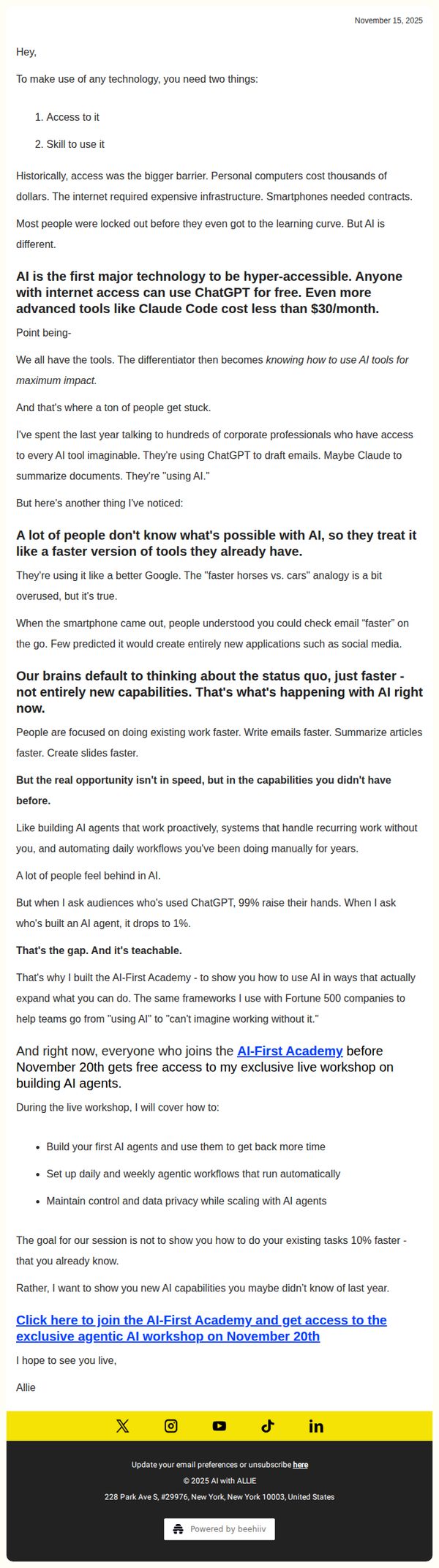
This email aims to reframe the reader’s perception of AI from a speed tool to a capability-expanding technology, positioning the AI-First Academy as the solution to bridge the knowledge gap and drive sign-ups for an exclusive live workshop before the November 20th deadline.
Why this works
The email brilliantly reframes AI not as a productivity accelerator but as a capability-expanding force, helping readers realize they’re not behind, they’re just underutilizing tools they already have access to, which builds urgency without shame.
How to implement
By contrasting widespread ChatGPT usage with the rarity of building AI agents, the message creates a compelling knowledge gap that positions the AI-First Academy as the essential bridge, turning passive users into proactive builders with tangible, high-impact outcomes.
Pro Tip
Add a short testimonial or stat from a past workshop attendee near the CTA to reinforce credibility and reduce perceived risk, e.g., '92% of attendees built their first agent within 48 hours', to strengthen conversion momentum. • Include a visual element like a simple icon or divider before the bullet points listing workshop outcomes to break up text density and guide the eye toward the most compelling benefits, improving scannability and retention.
10. why you still feel behind after using ChatGPT daily
Objective
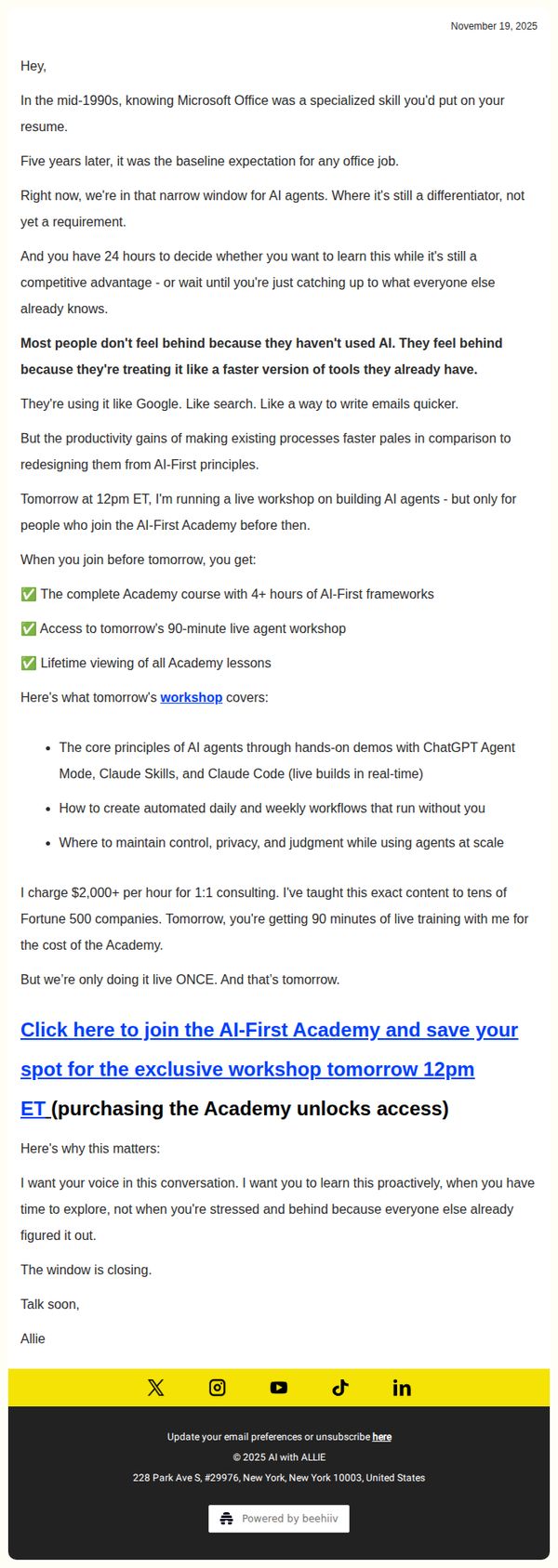
This email aims to convert readers into paying members of the AI-First Academy by highlighting the urgency and exclusivity of a live workshop, while reframing AI use from a productivity tool to a strategic advantage that requires foundational redesign.
Why this works
The email brilliantly reframes AI adoption not as a tool upgrade but as a strategic pivot, positioning users who treat AI like Google as falling behind, not because they’re inexperienced, but because they’re not redesigning workflows from first principles.
How to implement
By anchoring the live workshop to a limited-time, pre-enrollment requirement, the campaign creates scarcity without artificial pressure, making the offer feel exclusive and valuable while aligning with the educational mission of the Academy.
Pro Tip
Add a countdown timer or 'X spots left' indicator near the CTA to visually reinforce urgency and scarcity, especially since the workshop is live-only and time-bound, which could increase conversion without adding friction. • Include a short 1–2 sentence testimonial from a past attendee or Fortune 500 client to validate the claim that this content is taught to elite organizations, thereby reducing perceived risk for new buyers.