Proven Gerber Life email designs you can use
1. Get coverage that grows with your child
Objective
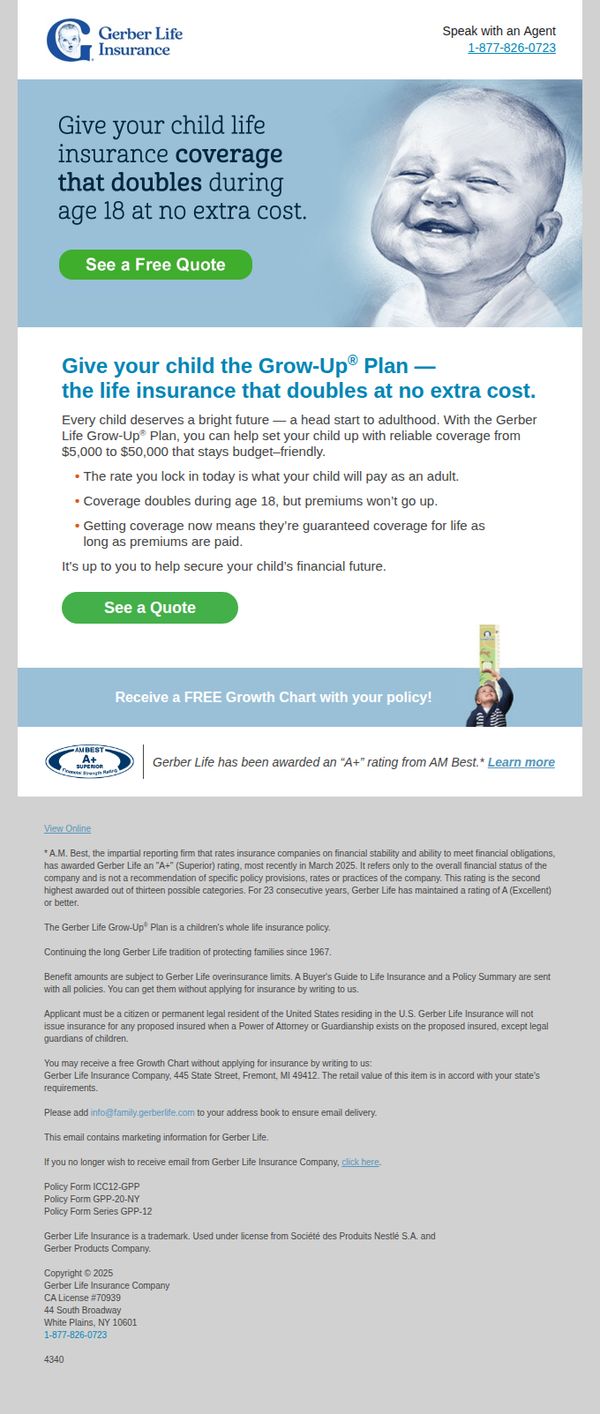
The email aims to persuade parents to secure life insurance for their child by highlighting the unique benefit of coverage that doubles at age 18 without increasing premiums, positioning Gerber Life as a trusted, long-term partner in their child’s financial future.
Why this works
The email brilliantly frames life insurance not as a morbid necessity but as a proactive gift for a child’s future, using emotional language like 'bright future' and 'head start to adulthood' to align with parental aspirations.
How to implement
By emphasizing that coverage doubles at age 18 without extra cost, the campaign turns a complex financial product into a simple, compelling value proposition that speaks directly to budget-conscious parents seeking long-term security.
Pro Tip
Add a subtle countdown timer or urgency cue near the CTA to encourage immediate action, since life insurance is often deferred, even a simple 'Limited-time offer for new policies' could boost conversion. • Include a short testimonial or quote from a real parent who purchased the Grow-Up Plan, ideally with a photo, to humanize the offer and build trust beyond the AM Best rating.
2. Future proofing with the Grow-Up® Plan
Objective
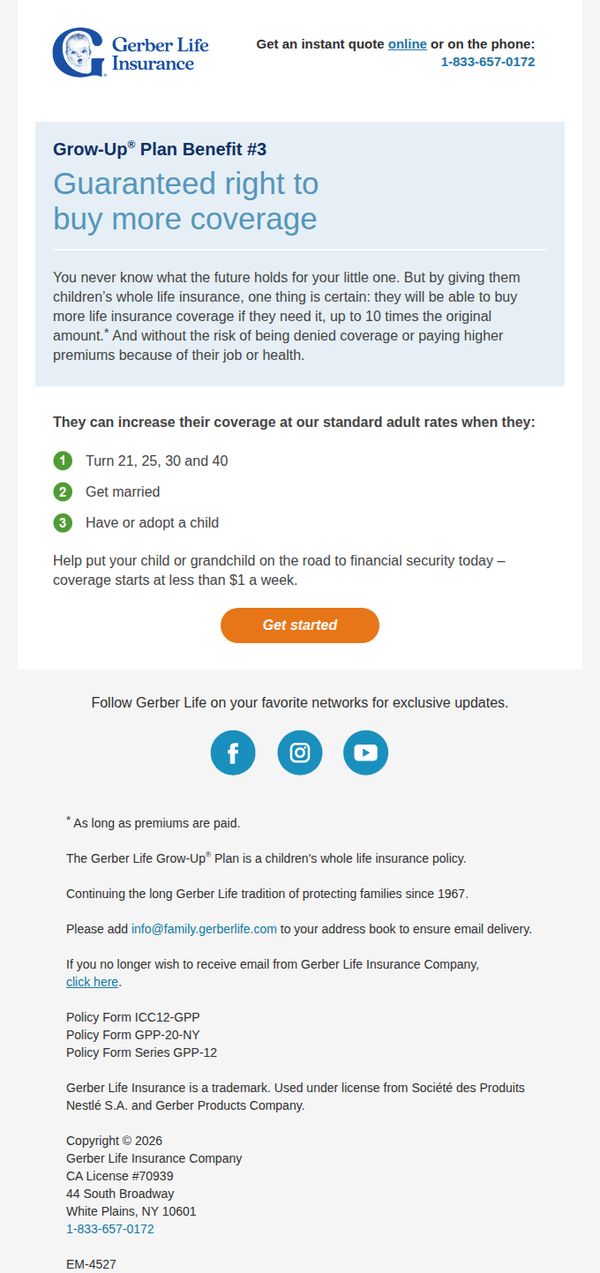
To encourage parents and grandparents to secure their child’s long-term financial protection by highlighting the Grow-Up® Plan’s unique benefit of guaranteed future coverage at standard adult rates, regardless of health or job changes. The email aims to drive immediate action through a simple, low-cost entry point.
Why this works
The email smartly frames life insurance not as a grim necessity but as a forward-thinking gift, positioning the Grow-Up® Plan as a loving, proactive step parents can take to lock in lifelong security for their child without worrying about future health or employment hurdles.
How to implement
By specifying exact life milestones, turning 21, 25, 30, 40, getting married, or having a child, the email makes abstract future needs feel tangible and timely, helping recipients visualize exactly when and why this coverage will matter most to their growing family.
Pro Tip
Add a brief testimonial or quote from a parent who used the Grow-Up® Plan to ease anxiety about their child’s future, social proof would strengthen emotional resonance and credibility without cluttering the layout. • Include a small visual icon or badge next to the 'Get started' button indicating 'No medical exam required' or 'Guaranteed approval' to reduce perceived friction and reinforce the key selling point visually.
3. This rate won’t last
Objective
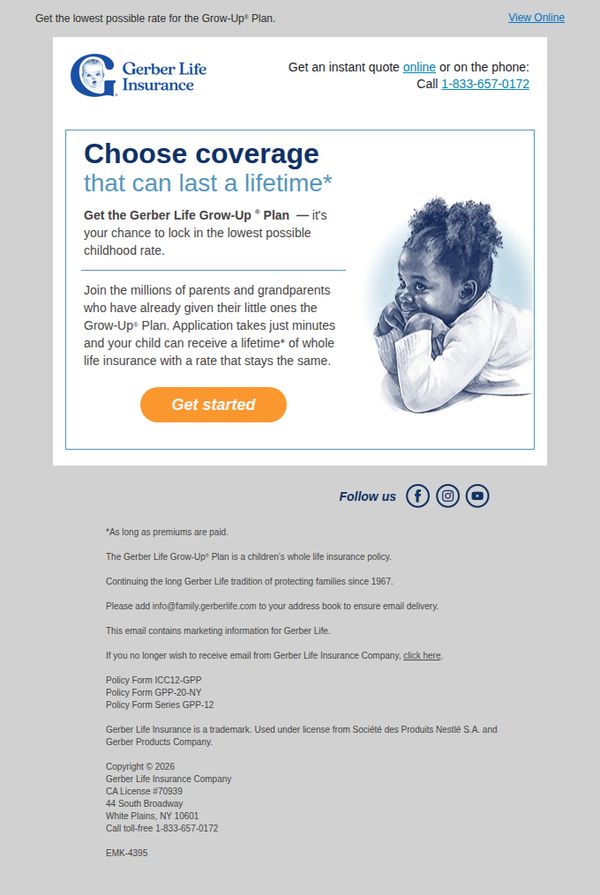
To drive immediate sign-ups for the Gerber Life Grow-Up Plan by emphasizing its unique value proposition, locking in the lowest possible childhood rate for lifetime coverage, and leveraging urgency through a time-sensitive offer.
Why this works
The email brilliantly frames the insurance plan as a timeless gift, not just a policy, by tying it to parental love and long-term security, which emotionally resonates with caregivers seeking to protect their child’s future.
How to implement
By highlighting that millions of parents have already chosen this plan, the campaign leverages powerful social proof while subtly implying that delaying could mean missing out on a widely trusted, limited-time benefit.
Pro Tip
Add a subtle countdown timer or 'limited spots available' indicator near the CTA to reinforce urgency visually, since the subject line implies scarcity but the body lacks real-time pressure cues. • Include a short testimonial or quote from a parent who locked in the rate early, even one sentence would strengthen trust and reduce perceived risk for hesitant prospects.
4. Child whole life insurance starting at $3.70 per month
Objective
To encourage parents to secure affordable, long-term life insurance for their children by highlighting low monthly premiums and future coverage benefits. The email aims to drive quote requests through clear pricing tiers and value-driven features.
Why this works
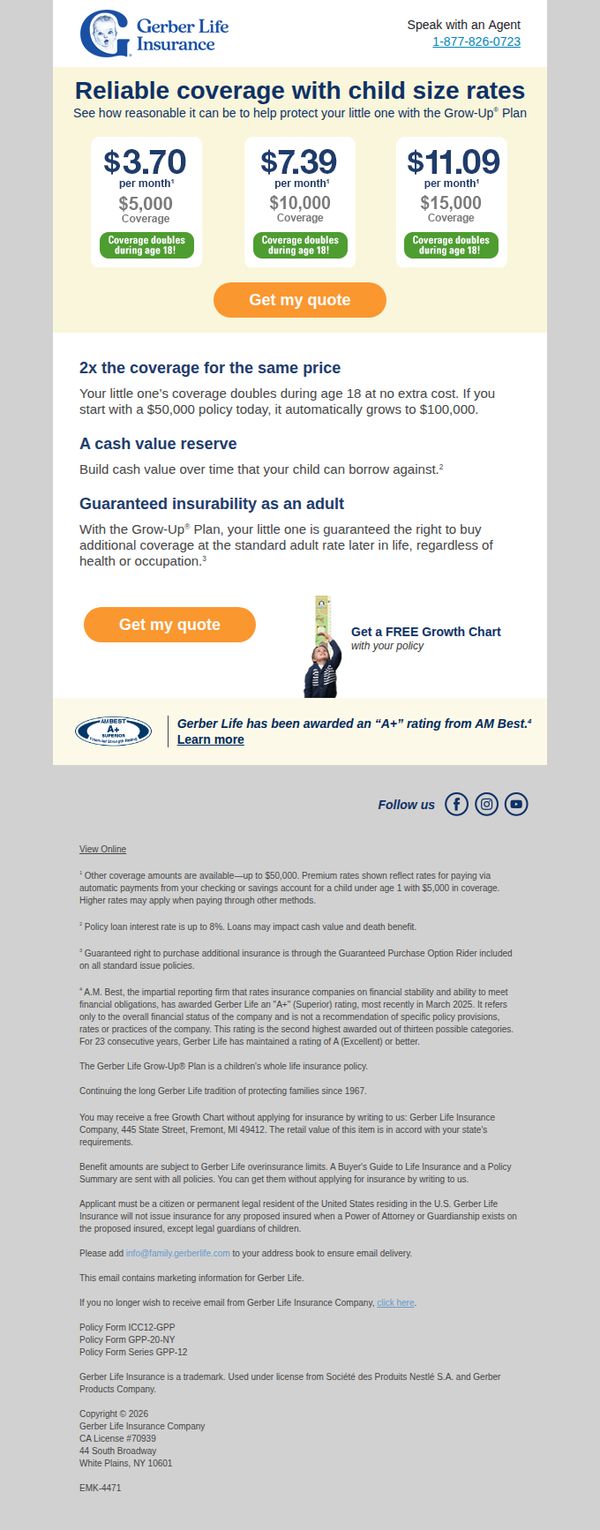
The email brilliantly simplifies complex insurance concepts by anchoring pricing to a child’s age and showing exactly how coverage doubles at 18, making long-term value instantly tangible for anxious parents.
How to implement
By featuring three clear pricing tiers with visual icons and green callouts, the campaign reduces decision fatigue and empowers parents to self-select the coverage level that matches their budget and peace of mind.
Pro Tip
Add a countdown timer or urgency indicator near the CTA to nudge procrastinating parents, since insurance decisions often get delayed, a subtle 'limited-time offer' or 'popular plan filling fast' could boost conversions. • Include a short testimonial or parent quote near the pricing tiers to humanize the offer, real stories from parents who bought coverage could strengthen emotional trust and reduce perceived risk.
5. Don't forget about your quote
Objective
This email aims to re-engage users who previously started but didn’t complete their life insurance quote, encouraging them to return and finalize the process by emphasizing simplicity and emotional connection to securing their child’s future.
Why this works
The email opens with empathy, acknowledging the recipient’s busy life while subtly reinforcing parental responsibility, making the offer feel supportive rather than salesy and increasing emotional resonance with the target audience.
How to implement
By positioning the insurance plan as something that 'grows with your little one,' the message transforms a transactional product into a lifelong commitment, aligning the brand with family values and long-term trust rather than just financial protection.
Pro Tip
Add a subtle countdown timer or urgency indicator near the CTA to encourage immediate action, since the current design lacks time-sensitive motivation despite targeting users who previously abandoned the quote process. • Include a short testimonial or social proof near the hero section, even one sentence from a parent, to reinforce credibility and reduce perceived risk, especially since life insurance decisions often involve emotional hesitation.
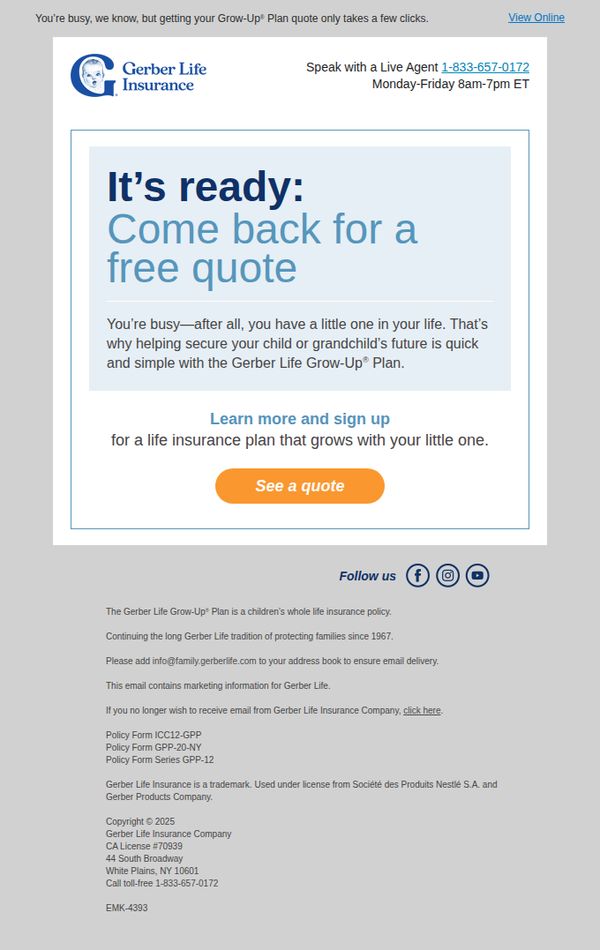
6. Don't forget about your quote
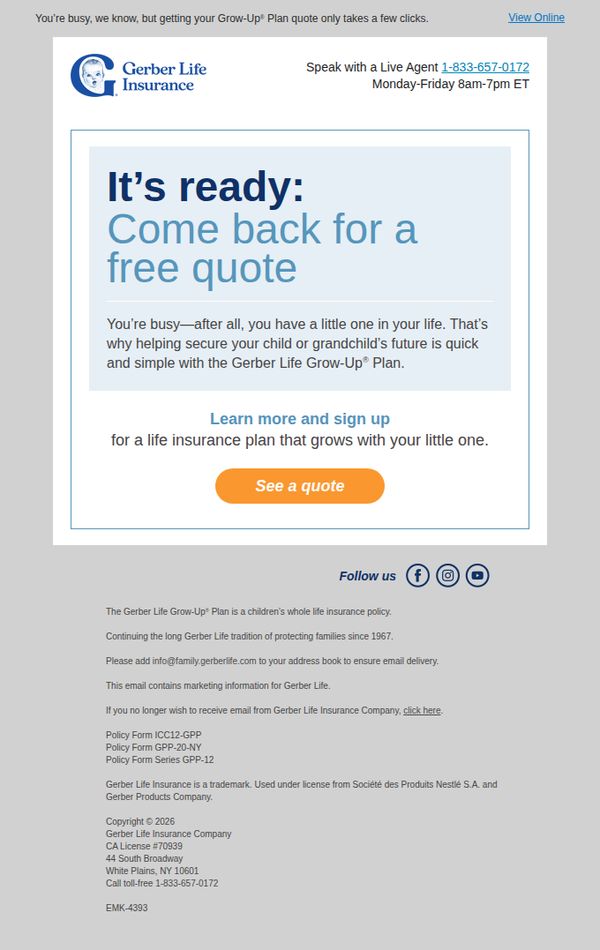
Objective
This email aims to re-engage users who previously started but didn’t complete their life insurance quote, reminding them that their personalized quote is ready and encouraging them to return and finalize enrollment for their child or grandchild’s future protection.
Why this works
The email opens with empathy, acknowledging the recipient’s busy life, then immediately reframes the action as quick and meaningful, reducing friction by positioning the quote as already prepared and waiting, not something to start from scratch.
How to implement
By tying the insurance product to a child or grandchild’s future, the message taps into emotional motivation rather than financial fear, making the offer feel nurturing and timely rather than transactional or intimidating.
Pro Tip
Add a brief testimonial or social proof near the CTA, such as 'Over 10,000 parents completed their quote last month', to reduce hesitation and reinforce trust in the ease and popularity of the process. • Include a subtle countdown or time-sensitive indicator (e.g., 'Your quote expires in 48 hours') to create urgency without pressure, encouraging immediate action while respecting the recipient’s autonomy.
7. When an accident happens, it's too late
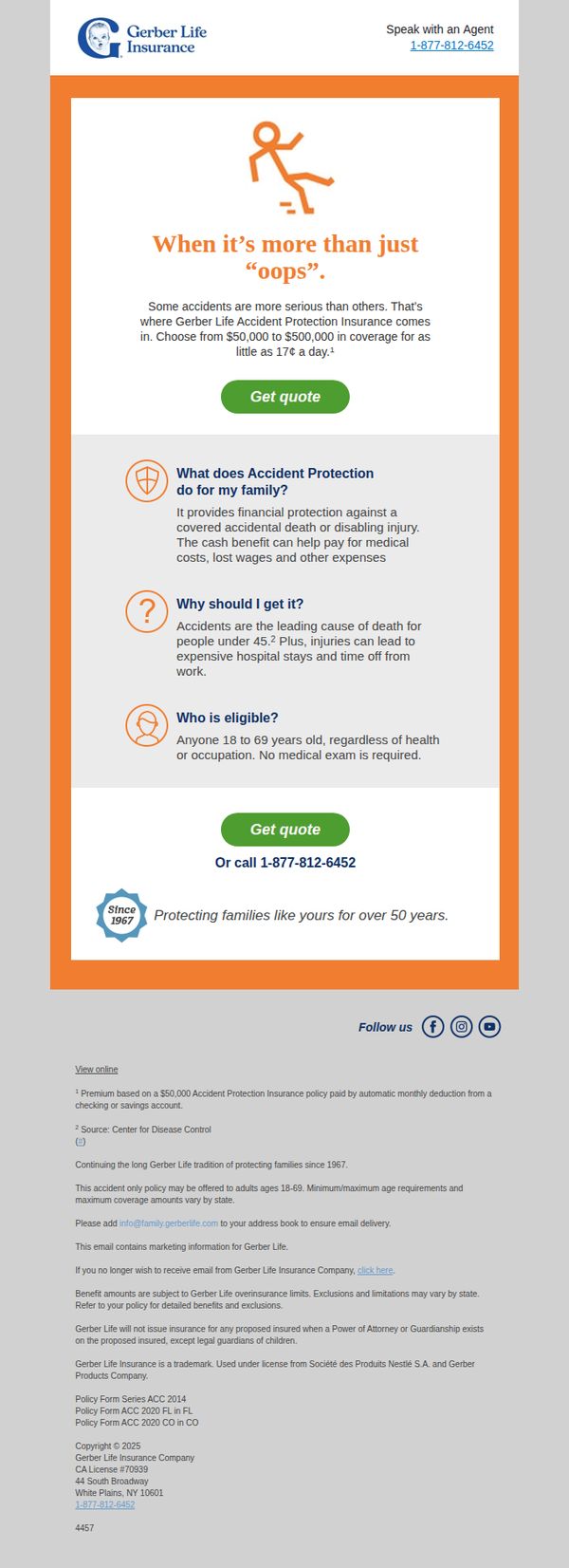
Objective
This email aims to drive immediate action by highlighting the urgency of securing accident protection insurance before an unexpected event occurs, positioning Gerber Life as a trusted, long-standing solution for families facing financial risk from accidents.
Why this works
The email opens with a powerful emotional hook, 'When it’s more than just oops', immediately reframing accidents as life-altering events, which primes the reader to see insurance not as optional but as essential protection for their family’s financial stability.
How to implement
By anchoring the offer in a tangible, low daily cost, 'as little as 17¢ a day', the campaign makes a potentially intimidating financial product feel accessible and affordable, reducing psychological barriers to engagement while still emphasizing substantial coverage amounts.
Pro Tip
Add a subtle countdown timer or urgency indicator near the CTA to reinforce the 'too late' theme and encourage immediate action, since the current design relies solely on emotional appeal without time-sensitive pressure. • Include a short testimonial or real-life scenario in the education section to humanize the risk, e.g., 'One family received $50,000 after a car accident', to make the abstract benefit of coverage feel concrete and emotionally resonant.
8. This Grow-Up® Plan benefit builds over time...
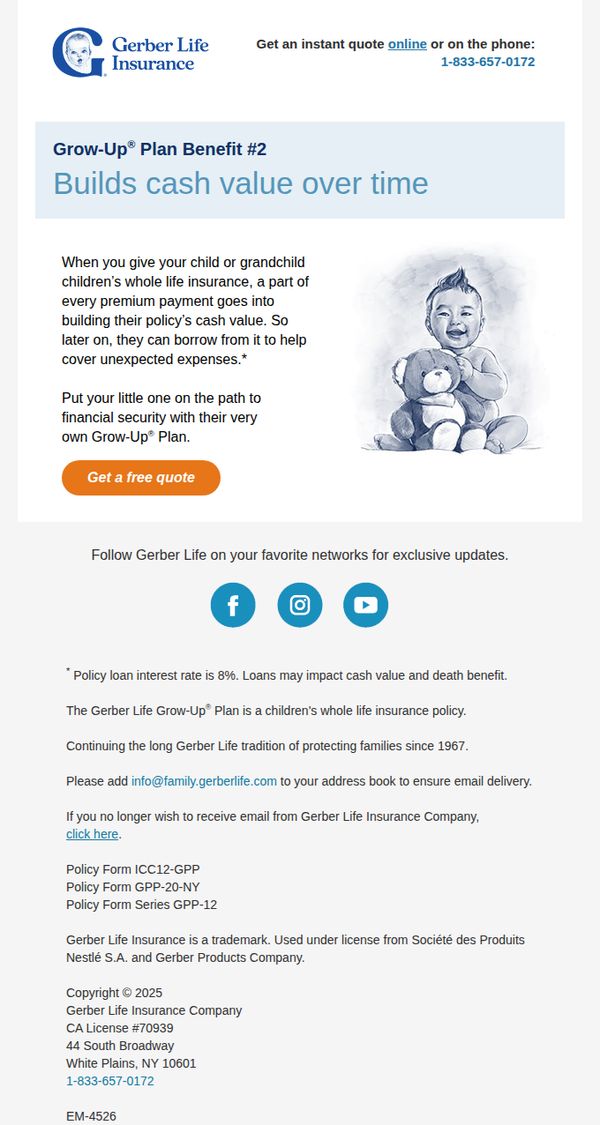
Objective
This email aims to educate parents and grandparents about the long-term financial benefits of Gerber Life’s Grow-Up® Plan, specifically how it builds cash value over time to help cover future expenses. It encourages immediate action by prompting recipients to get a free quote.
Why this works
The email smartly frames the insurance policy not just as protection, but as a growing financial asset for the child, making it emotionally resonant and practically appealing to forward-thinking parents.
How to implement
By pairing a warm, hand-drawn illustration of a happy child with a clear benefit explanation, the email creates an instant emotional connection while delivering complex financial value in simple, digestible terms.
Pro Tip
Add a brief testimonial or real-life example near the CTA to reinforce trust, for instance, a parent sharing how the cash value helped cover college or medical costs, making the benefit feel tangible. • Include a subtle countdown or urgency trigger (e.g., 'Limited-time enrollment window') near the CTA to nudge procrastinators, since the current design lacks time-sensitive motivation despite the financial nature of the offer.
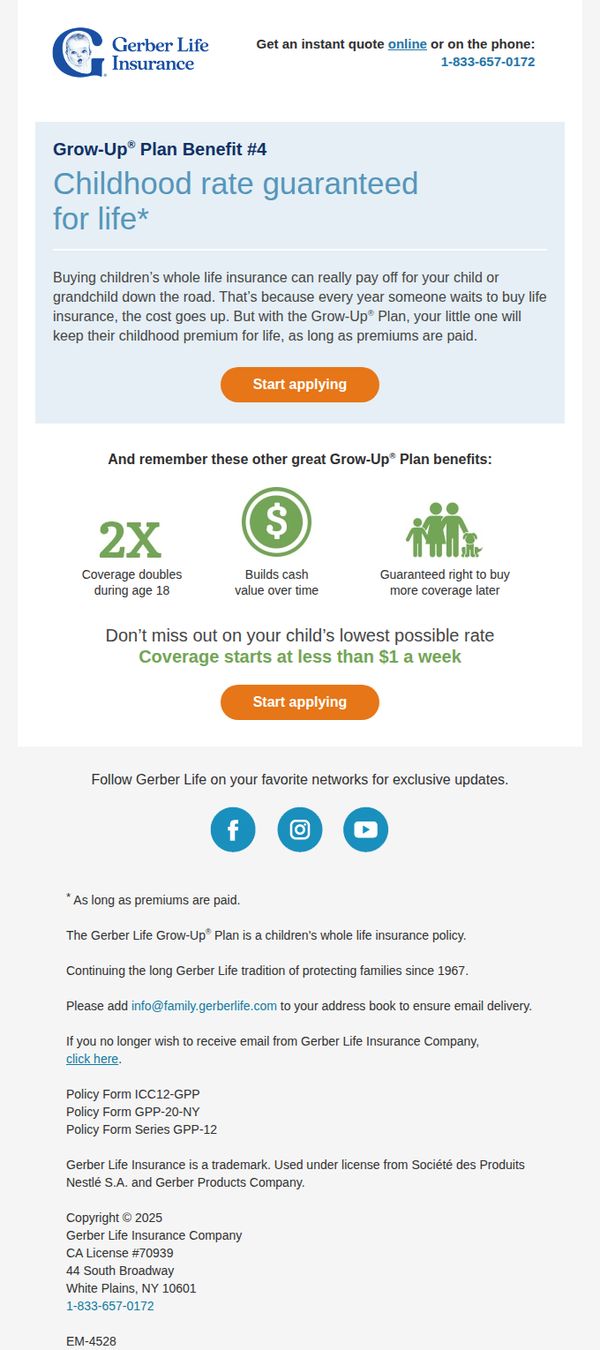
9. One more thing to know: Your child's rate will never be lower
Objective
To persuade parents to secure life insurance for their child now by emphasizing that the childhood rate is locked in for life, creating urgency through the message that waiting will result in higher future costs.
Why this works
The email brilliantly leverages time-sensitive financial logic by reminding parents that delaying purchase locks in higher premiums later, a powerful emotional and economic trigger for protective decision-making.
How to implement
By positioning the childhood rate as ‘guaranteed for life,’ the campaign transforms a complex insurance concept into an intuitive, emotionally resonant promise that reassures anxious parents seeking long-term security for their kids.
Pro Tip
Add a visual countdown timer or progress bar near the CTA to amplify urgency, since the core message hinges on acting now before rates rise, this would strengthen behavioral nudges without adding clutter. • Include a short testimonial from a real parent who secured coverage early, highlighting how the locked-in rate gave them peace of mind, social proof would deepen trust and reduce perceived risk for hesitant readers.
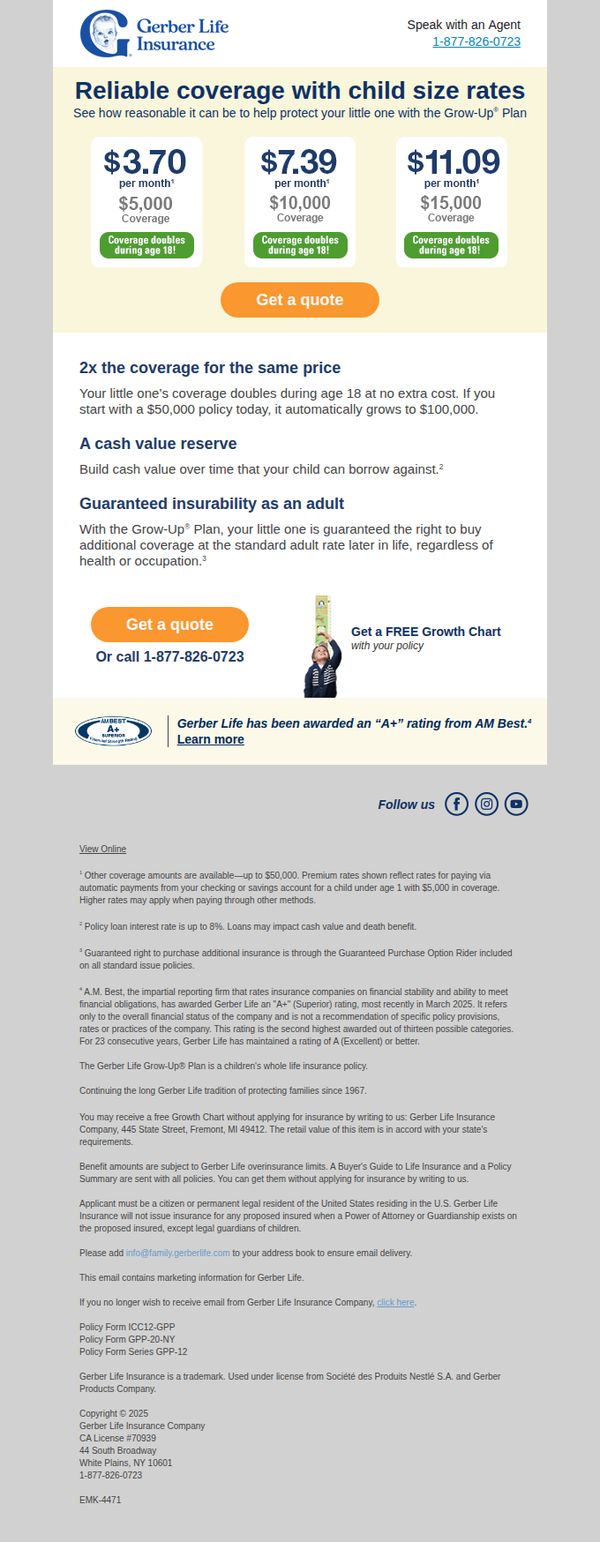
10. Child whole life insurance starting at $3.70 per month
Objective
This email aims to convert parents into leads by showcasing affordable, scalable child whole life insurance options through Gerber Life’s Grow-Up Plan, emphasizing long-term value and guaranteed future coverage at adult rates.
Why this works
The email brilliantly simplifies complex insurance concepts by anchoring pricing to relatable monthly amounts and visually pairing each tier with its coverage value, making it easy for overwhelmed parents to grasp the benefit-to-cost ratio at a glance.
How to implement
By highlighting that coverage doubles at age 18 without extra cost, the campaign taps into parental instincts to secure their child’s future, turning a financial product into an emotional promise of lifelong protection and peace of mind.
Pro Tip
Add a subtle countdown timer or urgency indicator near the CTA to encourage immediate action, since insurance decisions are often delayed, this would leverage FOMO without compromising the email’s calm, trustworthy tone. • Reposition the ‘Get a FREE Growth Chart’ offer closer to the primary CTA or integrate it as a secondary CTA button, since it’s a high-value incentive that could increase conversion by reducing perceived risk and adding tangible value upfront.