Scientific American emails worth copying
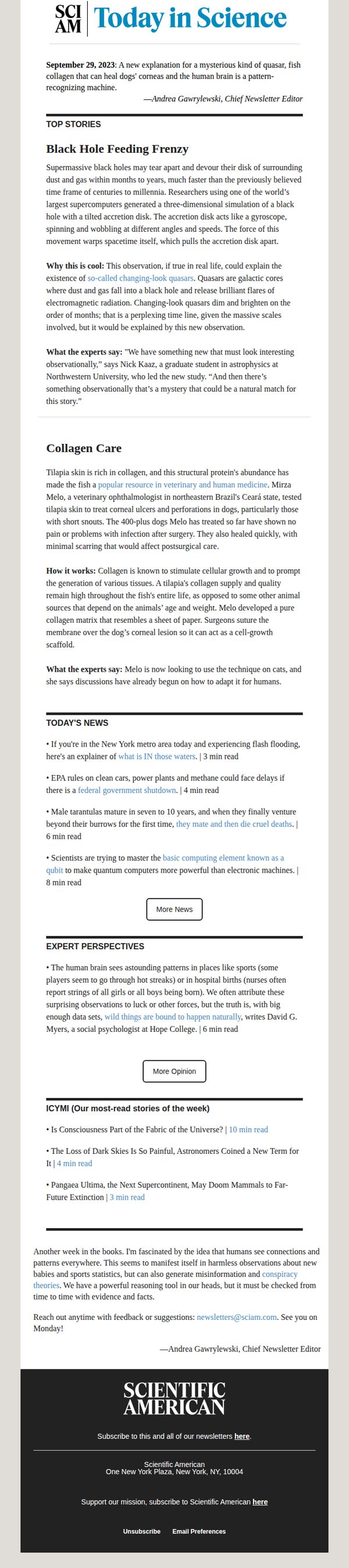



1. Today in Science: Fish collagen heals dogs' eyes
Objective
To inform subscribers of the latest scientific discoveries and developments in an engaging, digestible format while reinforcing Scientific American’s authority as a trusted science news source. The email encourages continued engagement through curated story sections and direct calls to action.
Why this works
The email opens with a surprising, emotionally resonant headline about fish collagen healing dogs’ eyes, a clever hook that blends novelty, animal welfare, and scientific innovation to instantly capture attention and set the tone for curiosity-driven reading.
How to implement
By structuring content into clearly labeled sections like 'Top Stories,' 'Today’s News,' and 'Expert Perspectives,' the email guides readers through a logical, digestible journey that mirrors how people naturally consume news, from breaking updates to deeper analysis, without overwhelming them.
Pro Tip
Add a secondary CTA button beneath 'More News' that says 'Subscribe to All Newsletters', this would capitalize on high engagement moments by offering deeper commitment options without disrupting the primary reading flow. • Incorporate a subtle visual cue, like a small icon or color highlight, next to each article’s read time to help readers quickly assess time investment, increasing the likelihood they’ll click based on perceived value and availability.
2. Today in Science: Artificial lungs rescue near-death patient
Objective
To engage readers with compelling, timely science stories that highlight medical breakthroughs and cosmic discoveries, while subtly encouraging newsletter subscriptions and deeper interaction through quizzes and discussion prompts.
Why this works
The email opens with a dramatic, human-centered medical breakthrough, artificial lungs saving a near-death patient, which immediately hooks readers by connecting high-stakes science to real human survival, making complex innovation feel urgent and personal.
How to implement
By embedding interactive elements like a science quiz and a call to join the discussion, the campaign transforms passive readers into active participants, fostering community and increasing time-on-content without disrupting the editorial tone or scientific credibility.
Pro Tip
The primary CTA 'Join the Discussion' is buried under a long news list and lacks visual prominence; elevating it with a contrasting button color or moving it above the fold would increase engagement without compromising editorial flow. • The 'Play Now' quiz section feels disconnected from the rest of the content; integrating a teaser question into the 'Top Stories' section or tying the quiz topic to the artificial lungs story would create narrative continuity and improve conversion.
3. Today in Science: EPA slapped with a lawsuit
Objective
To inform subscribers of timely science news and curated stories while subtly encouraging engagement through event sign-ups and subscription renewals. The email positions Scientific American as a trusted source for digestible, impactful science coverage.
Why this works
The email masterfully blends breaking news with evergreen science storytelling, creating a sense of urgency while also inviting deeper exploration, perfect for retaining curious readers who crave both timeliness and depth.
How to implement
By embedding a compelling event promotion within the newsletter’s natural flow, Scientific American turns passive readers into active participants without disrupting the editorial tone, making the CTA feel like a natural extension of the content.
Pro Tip
The event CTA is visually buried beneath the infographic; relocating it to above the fold or adding a sticky banner would increase visibility and conversion without disrupting the editorial experience. • The 'What We’re Reading' section lacks visual hierarchy, adding icons or small thumbnails for each linked article would improve scannability and encourage more click-throughs from casual readers.
4. Exclusive content written by more than 200 Nobel Prize winners
Objective
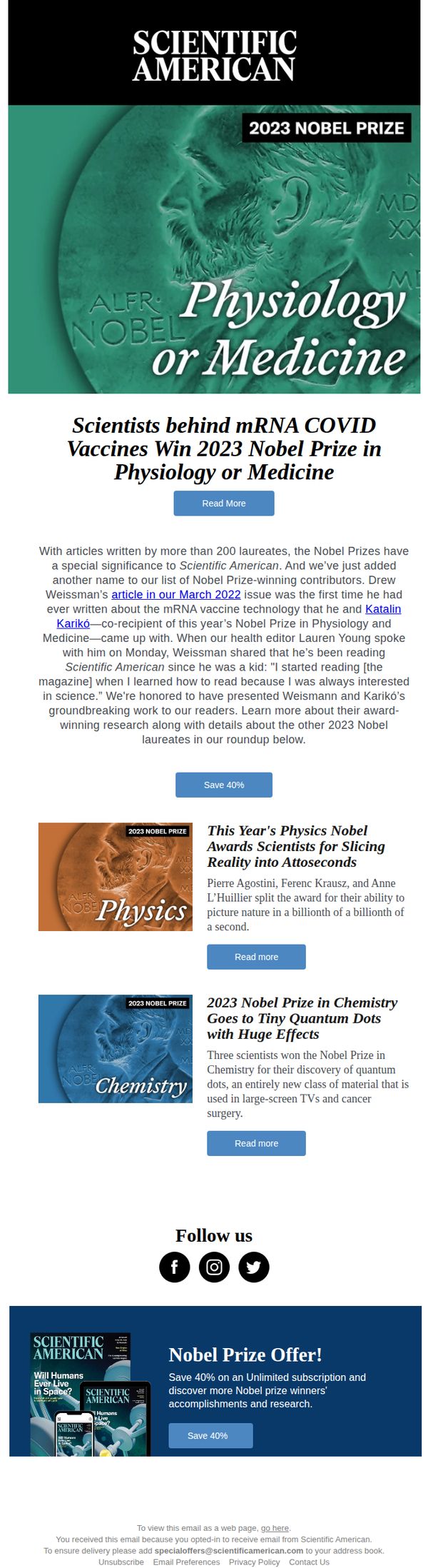
To highlight Scientific American’s exclusive access to Nobel Prize-winning scientists and their groundbreaking research, while driving subscriptions through a limited-time 40% discount offer tied to the 2023 Nobel Prize announcements.
Why this works
By anchoring its content to the prestige of Nobel laureates, Scientific American positions itself not just as a science magazine but as a curator of elite, authoritative knowledge that readers can’t get anywhere else, a powerful trust-building tactic.
How to implement
The email strategically layers emotional storytelling, like Drew Weissman’s childhood love of the magazine, with hard science to humanize Nobel winners and make their achievements feel personally relevant, increasing reader investment in the content.
Pro Tip
Add a countdown timer next to the 'Save 40%' CTA to create urgency, since the Nobel Prize announcements are time-sensitive and the offer feels more compelling when framed as a limited window to access exclusive laureate content. • Include a short testimonial or quote from a current subscriber who discovered a Nobel laureate’s work through Scientific American, this would strengthen social proof and bridge the gap between prestige and personal relevance for new readers.
5. Earth & Environment: EPA rolls back crucial climate policy
Objective
This email aims to inform subscribers about the EPA’s rollback of a key climate policy while reinforcing Scientific American’s role as a trusted source for science-based environmental reporting. It also seeks to drive engagement through story clicks and encourage newsletter subscriptions to sustain independent science journalism.
Why this works
The email opens with a timely cultural hook, Lunar New Year, to soften the entry into heavy policy news, making complex environmental regulation feel more approachable and human-centered without sacrificing scientific rigor.
How to implement
By embedding a clear, emotionally resonant call to action within a content-rich layout, the email transforms passive readers into potential supporters, subtly linking the urgency of climate policy to the sustainability of the journalism itself.
Pro Tip
The primary CTA is buried mid-email and visually underwhelming; relocating it to the top or bottom with a contrasting button design would increase conversion by making the subscription ask more prominent and actionable. • The hero section’s headline and image are strong, but the subhead lacks urgency or emotional framing, adding a short, impactful phrase like 'This rollback could endanger millions' would heighten reader motivation to engage.
6. Today in Science: New killer fungus discovered

Objective
To inform subscribers about the latest scientific discoveries and climate-related events in an engaging, digestible format while reinforcing Scientific American’s authority in science journalism. The email also aims to drive continued engagement through article clicks and newsletter subscriptions.
Why this works
The email opens with a vivid, narrative-driven headline about a newly discovered killer fungus, immediately capturing curiosity while grounding the story in real-world relevance, this storytelling approach transforms complex science into compelling human-interest content that readers can’t scroll past.
How to implement
By embedding expert commentary directly beneath each major story, the email builds credibility without overwhelming the reader, allowing authority figures to validate the science while keeping the tone conversational and accessible, perfect for readers who want depth without jargon.
Pro Tip
Add a visual hierarchy to the 'Today’s News' section using icons or small thumbnails next to each bullet point to increase scannability and reduce cognitive load, helping readers quickly identify topics of interest without reading full headlines. • Include a time-sensitive element, like a 'Read this before it’s buried in your inbox' tag or a 'Top 3 stories this week' badge, to create urgency and encourage immediate clicks, especially since the content is time-sensitive and tied to current events.
7. 🐾Celebrating National Pet Day
Objective
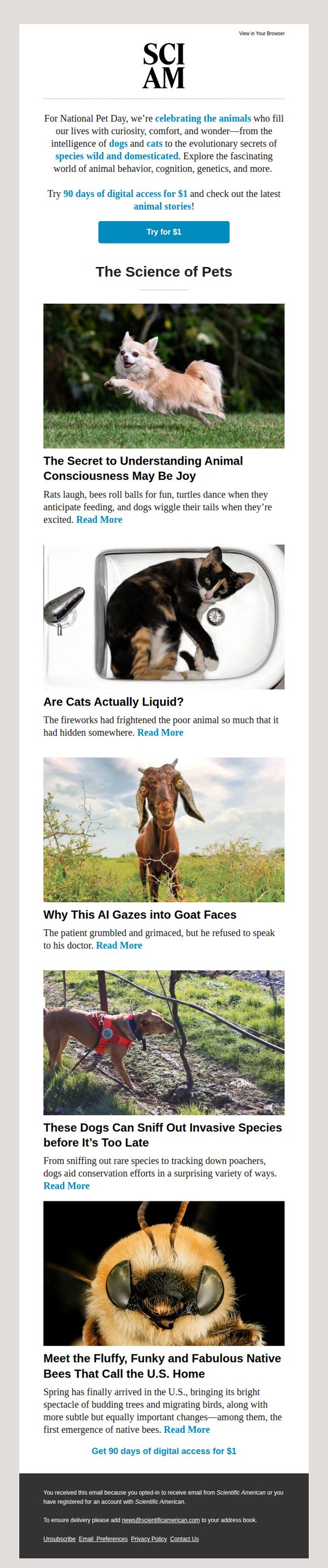
This email aims to celebrate National Pet Day by engaging readers with science-backed animal stories while converting interest into subscriptions through a limited-time $1 trial offer for 90 days of digital access.
Why this works
The campaign brilliantly ties a cultural moment, National Pet Day, to the brand’s scientific authority, making animal content feel both timely and intellectually rewarding rather than just cute or casual.
How to implement
Each article teaser uses quirky, curiosity-driven headlines paired with vivid imagery to create irresistible click momentum, proving that even complex science can be made accessible and entertaining through playful framing.
Pro Tip
Add a subtle countdown timer near the CTA to create urgency around the 90-day trial, since the current design lacks time-sensitive cues that could boost conversion rates for time-sensitive offers. • Include a short testimonial or subscriber stat (e.g., 'Join 500K+ science lovers') near the CTA to build social proof, which would strengthen trust and reduce perceived risk for new subscribers.
8. Today in Science: Did scientists just find da Vinci's DNA?

Objective
This email aims to engage readers with timely, curiosity-driven science news while subtly promoting a Scientific American subscription by showcasing the depth and wonder of its content. It positions the brand as a trusted source for both breaking discoveries and deeper scientific storytelling.
Why this works
The email opens with a bold, emotionally resonant hook, Leonardo da Vinci’s potential DNA, that instantly taps into cultural fascination while grounding it in credible science, making complex research feel personally relevant and urgent to the reader.
How to implement
By weaving together breaking news, visual storytelling, and expert commentary, the email transforms a daily digest into a narrative journey that rewards curiosity, subtly reinforcing why a subscription delivers more than headlines, it delivers context, depth, and wonder.
Pro Tip
The primary CTA is buried in the footer; relocating a prominent, visually distinct 'Subscribe Now' button after the 'Start the New Year Right' section would capitalize on peak reader interest and reduce friction in conversion. • The 'Image of the Day' section lacks a clear narrative link to the main theme (da Vinci/DNA); adding a brief editorial note connecting cosmic imagery to human curiosity or scientific legacy would strengthen thematic cohesion and emotional resonance.
9. Today in Science: Quantum dots win the chemistry Nobel

Objective
This email aims to inform subscribers about the latest Nobel Prize in Chemistry awarded for quantum dots and highlight other timely science stories, while reinforcing Scientific American’s authority in science journalism and encouraging newsletter engagement.
Why this works
The email opens with a bold, timely hook, tying the Nobel Prize to quantum dots, immediately signaling relevance and prestige, which captures attention from science-savvy readers who value authoritative, breaking science coverage.
How to implement
By weaving in a quirky, humanizing detail, like the tradition of awarding frog statuettes to Nobel winners, the email balances technical depth with personality, making complex science feel approachable and memorable without sacrificing credibility.
Pro Tip
Add a visual countdown or badge near the Nobel section to emphasize the timeliness of the award announcement, reinforcing urgency and encouraging immediate engagement with the top story. • Include a brief, bold pull quote from the Nobel Committee or a featured scientist directly under the headline to amplify emotional resonance and credibility before diving into the technical explanation.
10. Today in Science: Does consciousness pervade the universe?

Objective
This email aims to engage readers with thought-provoking science topics, particularly around consciousness and seismic history, while reinforcing Scientific American’s authority in science journalism and encouraging newsletter retention through curiosity-driven content.
Why this works
The email opens with a bold, philosophical question about consciousness that immediately hooks intellectually curious readers, turning abstract science into a personal, existential inquiry that invites deeper engagement.
How to implement
By weaving together two seemingly unrelated stories, cosmic consciousness and earthquake forensics, the newsletter demonstrates how science connects disparate phenomena, making complex research feel relevant and narratively compelling to everyday readers.
Pro Tip
The primary CTA 'More News' is too generic; it should be more benefit-driven, such as 'Explore More Mind-Blowing Science' or 'Unlock Today’s Deep Dives,' to better align with the curiosity-driven tone of the content. • The footer’s subscription prompt is buried and visually underwhelming; it should be redesigned with a stronger visual hierarchy and a clear value proposition, such as 'Get Daily Science Insights Delivered to Your Inbox, Free.'