Shopify email gallery from real brands
1. 🤘 Why Liquid Death killed its brand guidelines
Objective
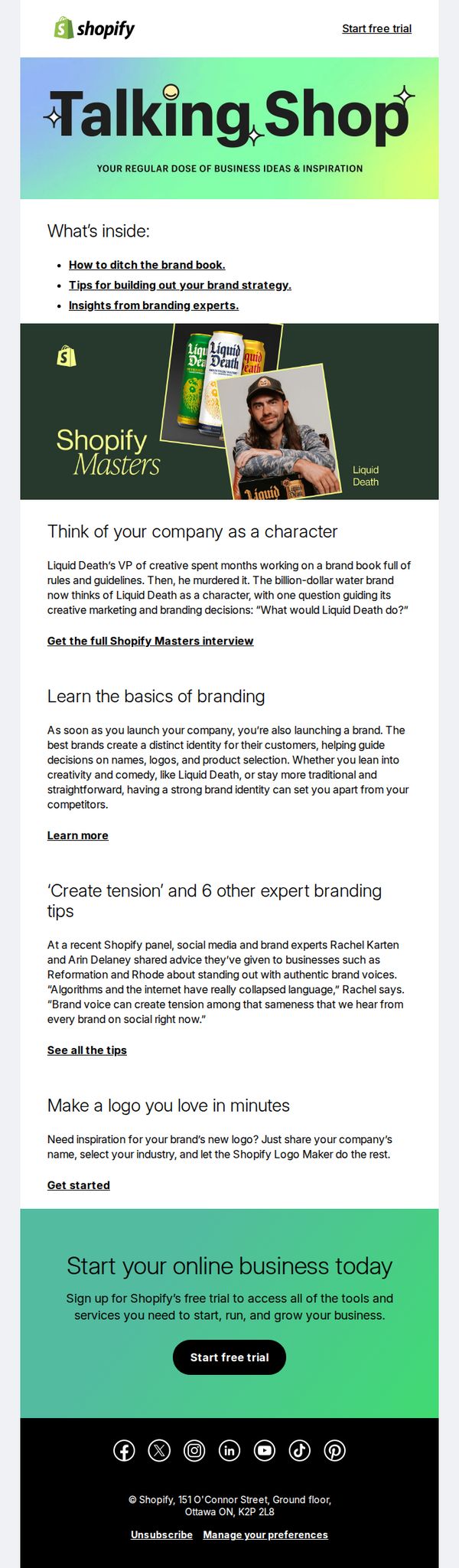
This email aims to inspire Shopify merchants by showcasing unconventional branding strategies, like Liquid Death’s rejection of traditional brand guidelines, to encourage bold, character-driven brand building while subtly promoting Shopify’s tools and free trial.
Why this works
Liquid Death’s decision to abandon rigid brand guidelines in favor of treating the brand as a living character demonstrates how personality-driven storytelling can cut through digital noise and build deeper emotional connections with audiences.
How to implement
By framing branding as a character with agency, asking 'What would Liquid Death do?', this campaign turns abstract marketing theory into an actionable, memorable decision-making tool that resonates with entrepreneurial creativity.
Pro Tip
Add a visual timeline or mini-case study graphic showing Liquid Death’s brand evolution, from rigid guidelines to character-driven chaos, to make the transformation more tangible and visually engaging for skimmers. • Reposition the 'Start free trial' CTA higher in the email, perhaps after the Liquid Death story, to capitalize on peak emotional engagement before readers scroll to educational content that may dilute urgency.
2. 🌸 Seasonal businesses to launch this spring
Objective
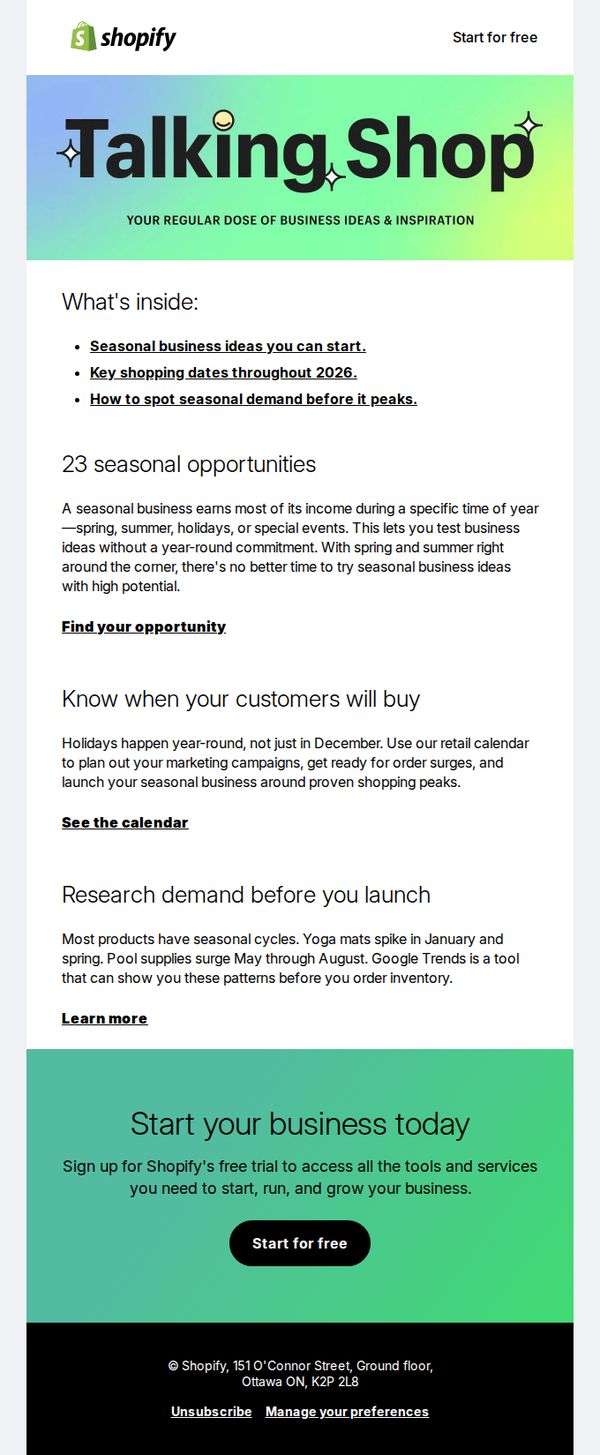
This email aims to inspire and guide entrepreneurs to launch seasonal businesses by highlighting timely opportunities, key shopping dates, and demand forecasting tools, all while encouraging sign-ups for Shopify’s free trial to turn ideas into reality.
Why this works
The email smartly frames seasonal business as low-risk experimentation by emphasizing short-term income windows, which reduces perceived commitment and appeals to hesitant entrepreneurs looking for flexible entry points.
How to implement
By embedding actionable tools like a retail calendar and Google Trends guidance, the email transforms abstract inspiration into concrete planning steps, making the path from idea to launch feel achievable and data-driven.
Pro Tip
Add a visual timeline or mini calendar graphic next to 'See the calendar' to make seasonal peaks more intuitive and scannable, reducing cognitive load and increasing engagement with the planning tool. • Include a short testimonial or case study from a merchant who successfully launched a seasonal business using Shopify, to build social proof and reinforce the credibility of the opportunity.
3. 💡 Your next business model: Digital products
Objective
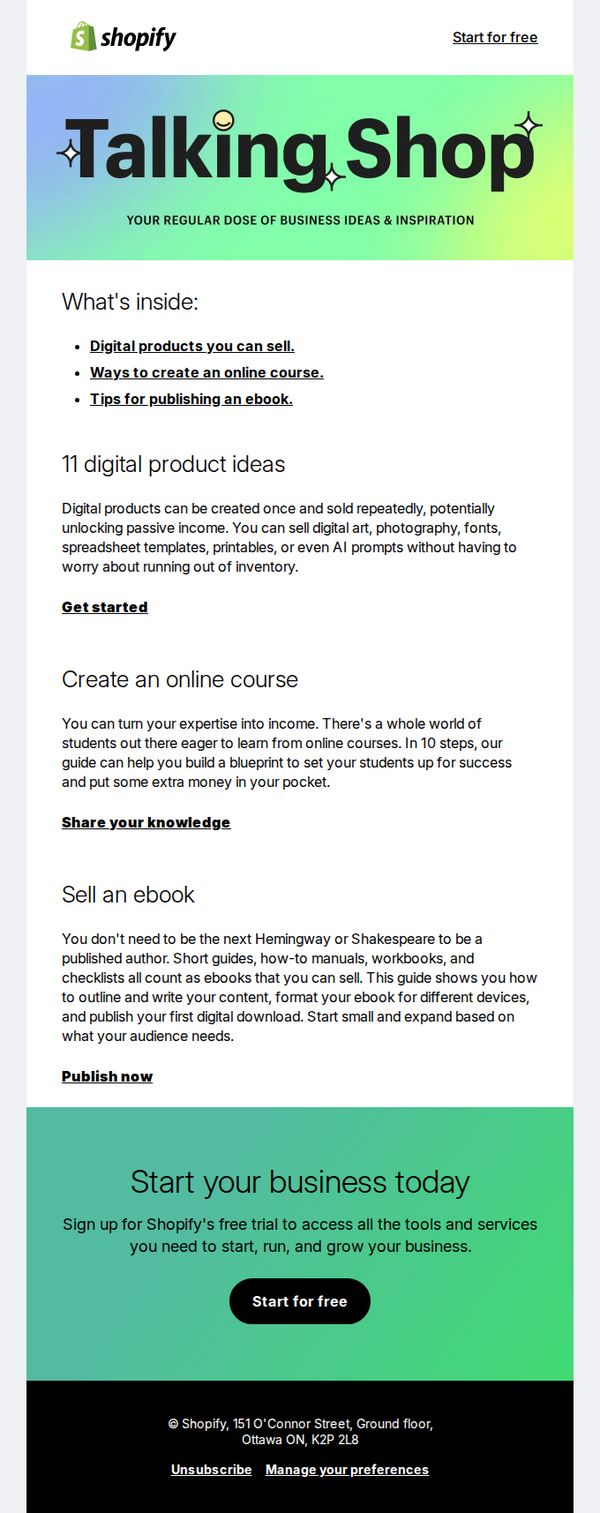
This email aims to inspire entrepreneurs to explore digital product creation as a scalable, inventory-free business model while driving sign-ups for Shopify’s free trial by positioning the platform as the ideal tool to launch and grow such ventures.
Why this works
The email brilliantly reframes digital products as a low-friction, high-reward business model by emphasizing passive income and zero inventory, a compelling hook that speaks directly to entrepreneurs seeking scalable, low-overhead opportunities.
How to implement
By breaking down complex ideas like creating online courses and publishing ebooks into digestible, step-by-step guides, the email reduces perceived effort and builds confidence in the reader’s ability to execute, a powerful psychological nudge toward action.
Pro Tip
Add a visual example or thumbnail of a digital product (e.g., an ebook cover or course interface) to make the abstract concept more tangible and emotionally resonant for readers unfamiliar with digital product creation. • Include a short testimonial or social proof near the CTA, such as ‘Over 10,000 entrepreneurs launched digital products with Shopify last month’, to reinforce credibility and reduce perceived risk for new users.
4. 💡 What business idea is right for you?
Objective
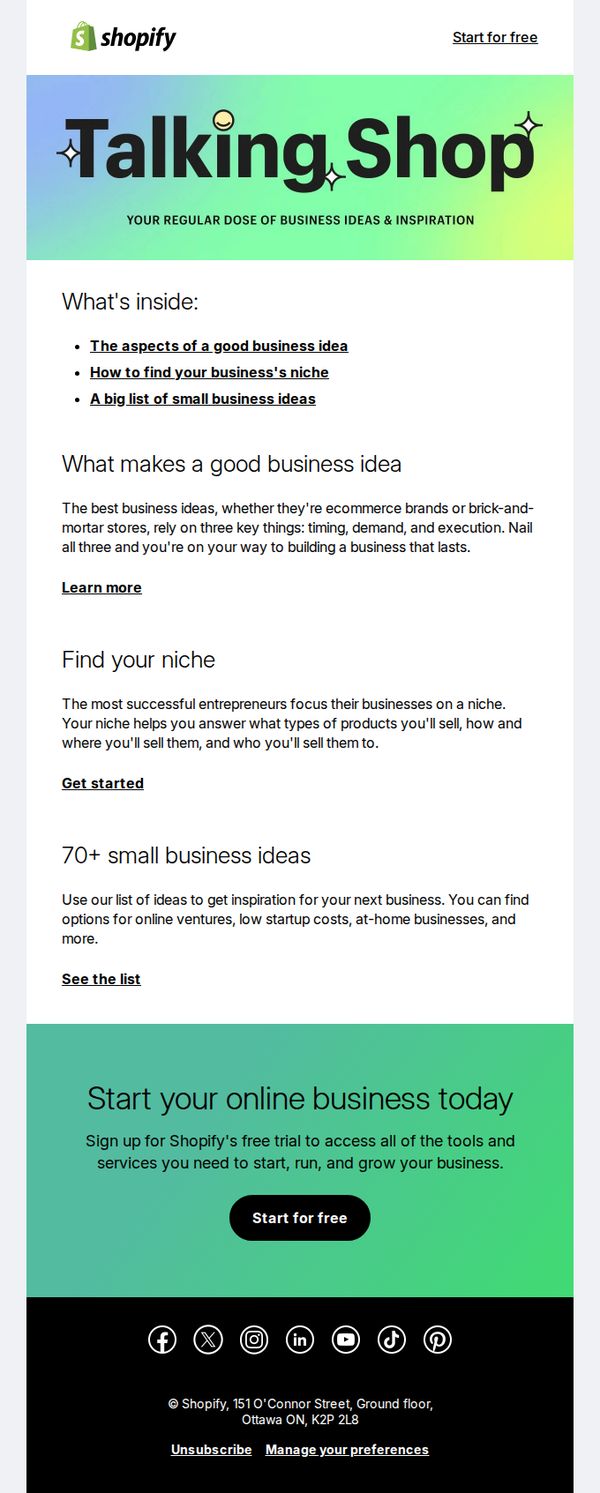
This email aims to inspire and guide aspiring entrepreneurs by offering actionable insights into selecting a viable business idea while subtly encouraging them to begin their journey with Shopify’s free trial. It positions Shopify as a trusted resource for business ideation and execution.
Why this works
The email smartly frames business ideation as a structured, learnable process, not luck, by breaking it into three pillars: timing, demand, and execution, which builds confidence in the reader’s ability to succeed with the right guidance.
How to implement
By teasing a 'big list of small business ideas' and offering niche-finding strategies, the email creates immediate perceived value, making the reader feel equipped to act rather than overwhelmed, which increases the likelihood of conversion.
Pro Tip
Add a visual progress bar or checklist under 'What’s inside' to gamify the content preview and subtly imply that reading the email is a step toward launching, increasing engagement and perceived value. • Include a micro-testimonial or success stat near the CTA (e.g., '10,000+ entrepreneurs started here last month') to reduce perceived risk and reinforce social proof right before the conversion point.
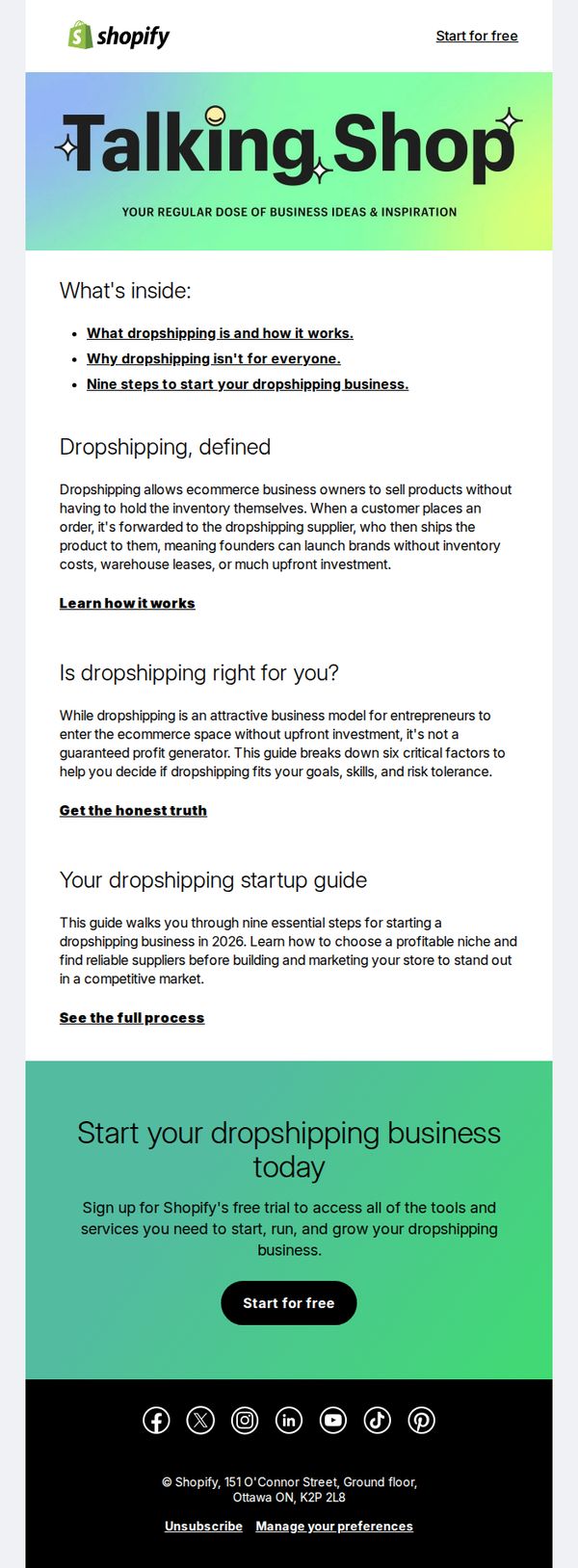
5. 📦 Your first business model: Dropshipping
Objective
This email aims to educate new entrepreneurs on dropshipping as a viable business model while guiding them toward signing up for Shopify’s free trial to begin building their store. It balances informational value with a clear conversion goal.
Why this works
The email smartly frames dropshipping not as a get-rich-quick scheme but as a strategic entry point into e-commerce, which builds trust by acknowledging its limitations while still positioning it as accessible and scalable for the right founder.
How to implement
By breaking the journey into nine essential steps, the email transforms an overwhelming concept into a digestible, actionable roadmap, giving readers a sense of control and momentum that motivates them to take the next step with Shopify.
Pro Tip
Add a subtle countdown timer or urgency indicator near the CTA to nudge procrastinators, since the offer is a free trial, implying limited-time access to onboarding support or bonus resources could increase conversion without compromising trust. • Include a short testimonial or founder quote after the 'Is dropshipping right for you?' section to humanize the decision-making process, social proof here would reinforce credibility and reduce perceived risk for hesitant readers.