How Command C Does Marketing Emails
1. Important: confirm your subscription
Objective
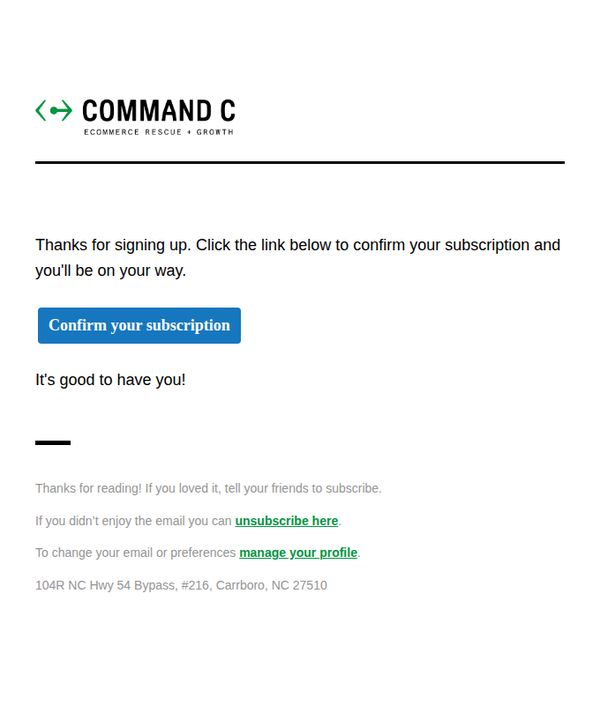
This email aims to verify new subscribers by prompting them to confirm their subscription, ensuring list hygiene and compliance while warmly welcoming them to the Command C community.
Why this works
The email opens with immediate gratitude and a clear, single-purpose CTA, reducing friction and guiding the user toward confirmation without overwhelming them with options or distractions.
How to implement
By adding a warm, personal touch with 'It's good to have you!' right after the CTA, the brand humanizes the transactional confirmation process, building early emotional connection and brand affinity.
Pro Tip
Add a brief value reminder above the CTA, such as 'Get weekly growth hacks for e-commerce brands', to reinforce why confirming is worth the user’s time and reduce drop-offs. • Include a visual indicator like a checkmark icon or progress bar next to the CTA to subtly signal that this is a quick, one-step process, reducing perceived effort and increasing completion rates.
2. From firefighting to calm, predictable growth
Objective
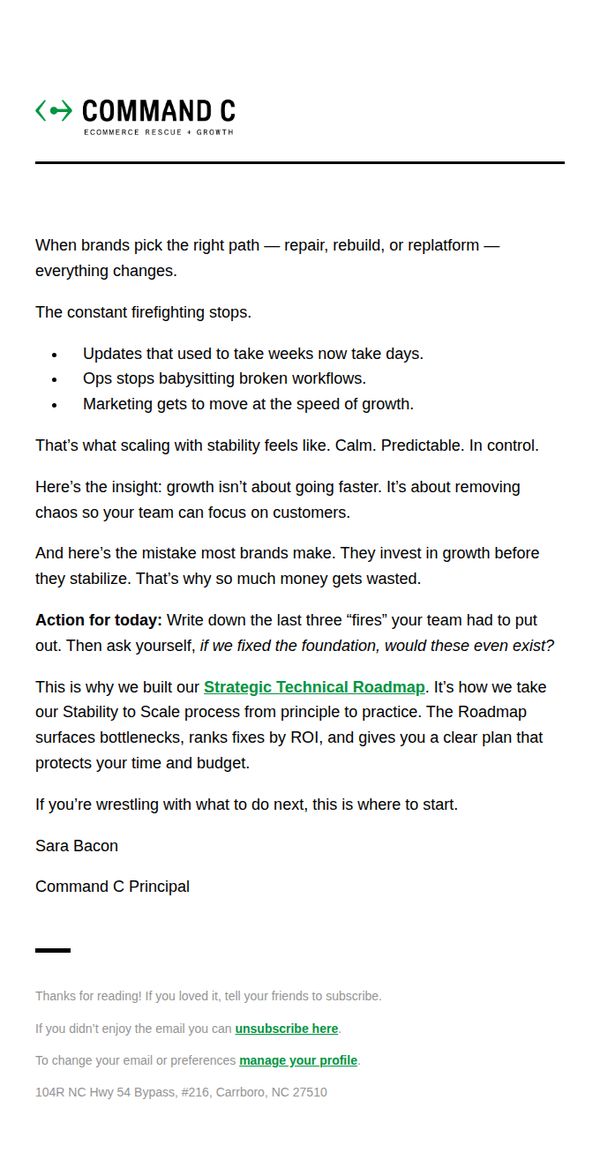
This email aims to position Command C as the solution for e-commerce brands stuck in reactive, chaotic growth cycles by reframing scalability as a function of stability, not speed, and prompting immediate reflection on operational pain points to prime the reader for their Strategic Technical Roadmap offering.
Why this works
The email brilliantly flips the script on growth by defining it not as velocity but as the removal of chaos, a counterintuitive yet deeply resonant framing that instantly repositions the brand as a strategic partner rather than just another tech vendor.
How to implement
By prompting the reader to list their last three 'fires,' the email transforms passive consumption into active self-audit, creating psychological ownership of the problem and making the subsequent solution feel personally necessary rather than merely interesting.
Pro Tip
Add a visual element, even a simple icon or divider, after the 'Action for today' prompt to visually separate the reflective exercise from the product explanation, improving scannability and reinforcing the behavioral nudge. • Include a micro-testimonial or client result snippet (e.g., 'Brand X reduced firefighting by 70% in 3 months') near the CTA to bridge the gap between insight and outcome, strengthening social proof without disrupting the email’s minimalist tone.
3. Why Shopify Plus Migrations Go Sideways
Objective
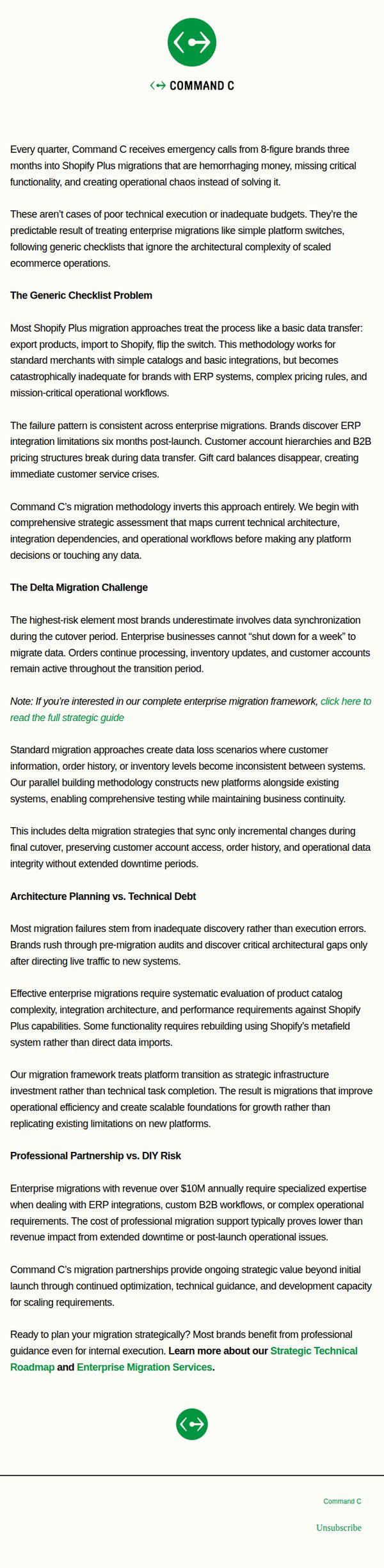
This email aims to position Command C as the expert solution for enterprise brands struggling with complex Shopify Plus migrations by exposing the hidden risks of generic approaches and showcasing their strategic, architecture-first methodology. It seeks to convert frustrated decision-makers into leads by offering a high-value strategic guide and services.
Why this works
Command C brilliantly reframes migration failures not as technical oversights but as strategic misalignments, making their solution feel indispensable to enterprise leaders who need to protect revenue and operations during platform transitions.
How to implement
By focusing on the 'delta migration challenge' and data synchronization risks during cutover, the email taps into a high-stakes, under-discussed pain point that resonates deeply with brands managing live customer data and inventory systems.
Pro Tip
Add a visual timeline or flowchart in the 'Delta Migration Challenge' section to illustrate how their parallel building methodology preserves business continuity, this would make the abstract concept more tangible and persuasive. • Include a short, authentic testimonial or case study metric (e.g., 'Reduced migration downtime by 90% for a $50M brand') near the CTA to reinforce credibility and reduce perceived risk for enterprise buyers.
4. The $300K mistake we see again and again
Objective
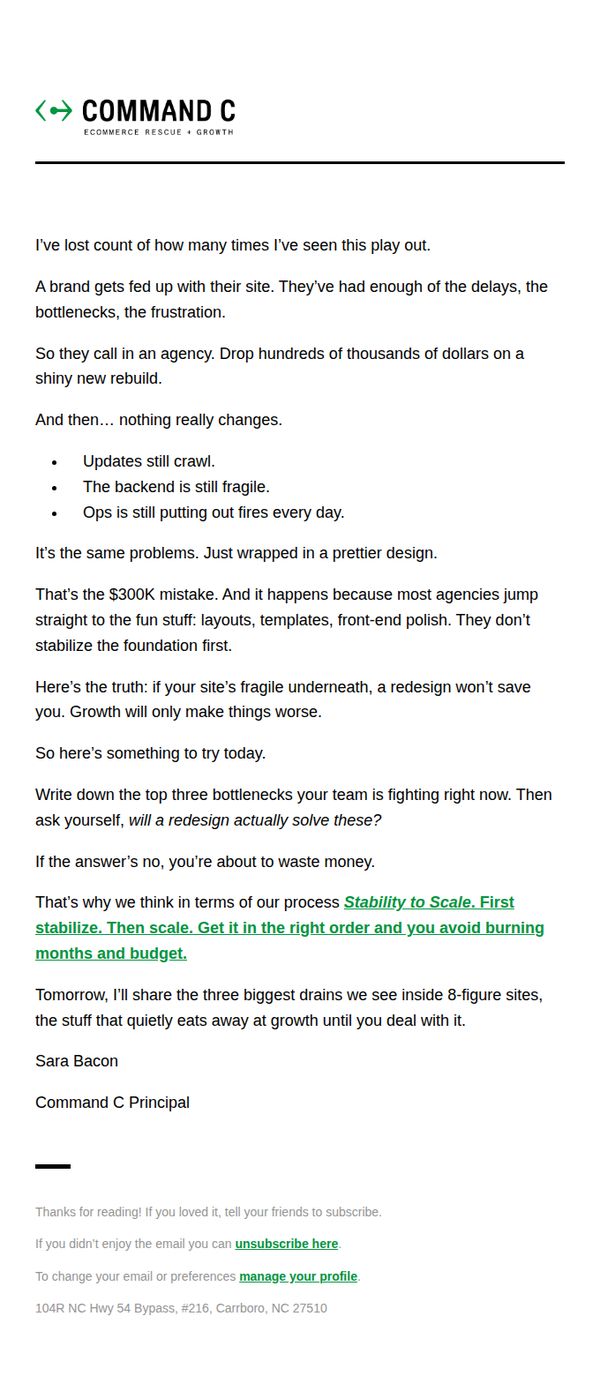
This email aims to position Command C as the strategic solution for e-commerce brands stuck in costly, ineffective website rebuild cycles by exposing a common $300K mistake and introducing their 'Stability to Scale' methodology as the smarter alternative.
Why this works
The email opens with a visceral, high-stakes hook, 'The $300K mistake', that immediately resonates with frustrated e-commerce founders who’ve burned cash on failed redesigns, making them lean in before they even realize they’re being sold a solution.
How to implement
Instead of leading with services or features, it frames the brand’s value around a counterintuitive truth: that growth requires stability first, a positioning that flips the script on typical agency messaging and positions Command C as the thoughtful, strategic alternative to flashy redesign shops.
Pro Tip
Add a visual hierarchy to the bullet points listing the ongoing problems (updates crawl, backend fragile, ops on fire), using icons or bolding, to make the pain points more scannable and emotionally resonant for time-poor founders skimming the email. • Include a micro-CTA after the 'Stability to Scale' line, such as 'Reply with “STABILITY” and we’ll send you our 5-point audit checklist', to capture immediate intent and turn passive readers into active leads without requiring them to click away.
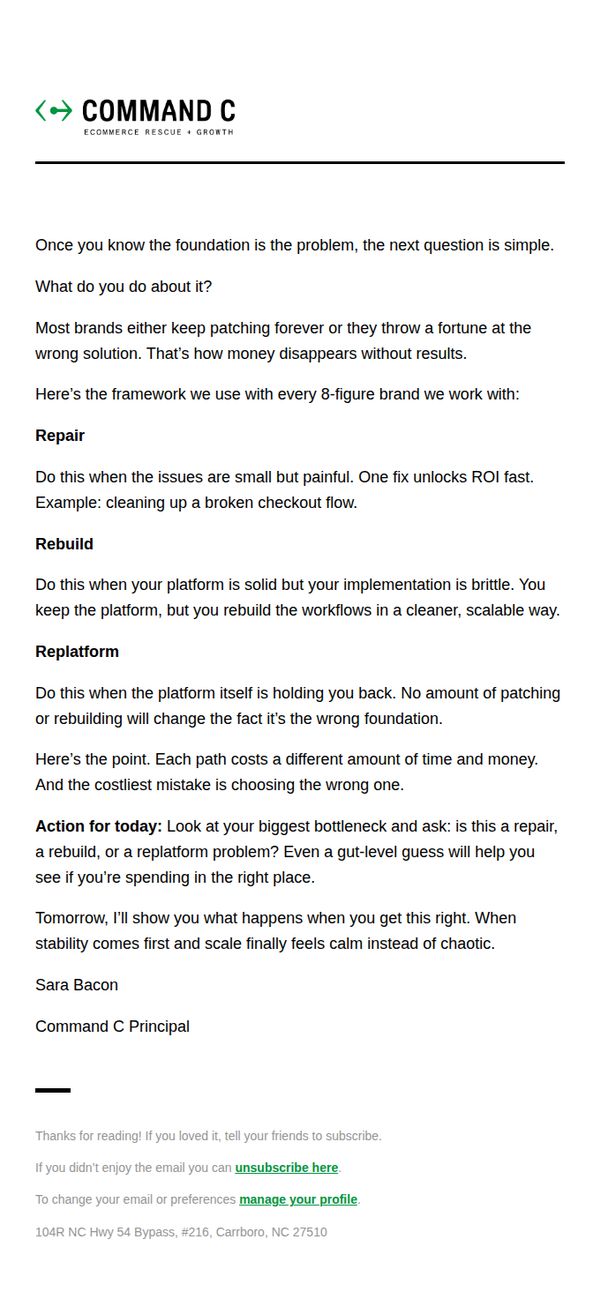
5. How to choose the right path forward
Objective
This email aims to guide e-commerce brands in diagnosing their operational bottlenecks by introducing a strategic framework, Repair, Rebuild, or Replatform, and encouraging immediate self-assessment to avoid costly missteps.
Why this works
The email brilliantly reframes technical e-commerce challenges as strategic decisions, Repair, Rebuild, or Replatform, giving overwhelmed founders a clear mental model to prioritize fixes without panic or overspending.
How to implement
By positioning the wrong choice as the costliest mistake, the message creates urgency without fearmongering, nudging readers toward honest self-audit rather than passive consumption of advice.
Pro Tip
Add a visual decision tree or flowchart next to the Repair/Rebuild/Replatform definitions to reduce cognitive load and increase retention of the framework’s logic. • Include a short testimonial or case study snippet from an 8-figure brand that used this framework successfully, this would validate the methodology and strengthen social proof within the education section.
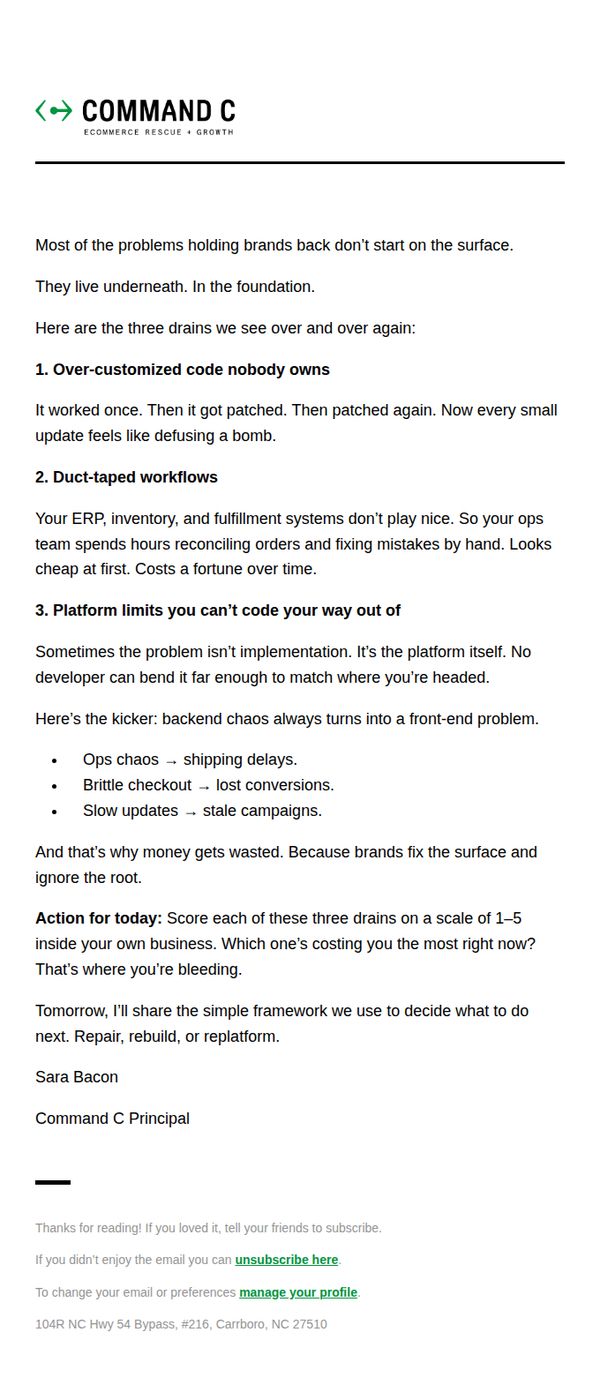
6. It’s not just your site, it’s your foundation
Objective
To educate ecommerce brands on hidden technical debt undermining their growth and prompt them to self-assess critical backend issues before offering a strategic framework for resolution.
Why this works
The email brilliantly reframes technical debt as 'foundation problems', a metaphor that instantly resonates with founders by connecting invisible backend chaos to tangible business outcomes like lost conversions and shipping delays.
How to implement
By naming three specific, relatable pain points, over-customized code, duct-taped workflows, and platform limits, the email gives readers immediate mental hooks to diagnose their own operations, making the problem feel both personal and solvable.
Pro Tip
Add a visual diagram or icon next to each of the three 'drains' to reinforce the metaphors visually, this would increase scanability and help busy founders grasp the concepts faster without sacrificing depth. • Include a micro-CTA button or link immediately after the scoring prompt (e.g., 'Start My Assessment') to capture intent while it’s high, rather than relying solely on text-based action which may get overlooked.