The complete Harvard Business Review email collection
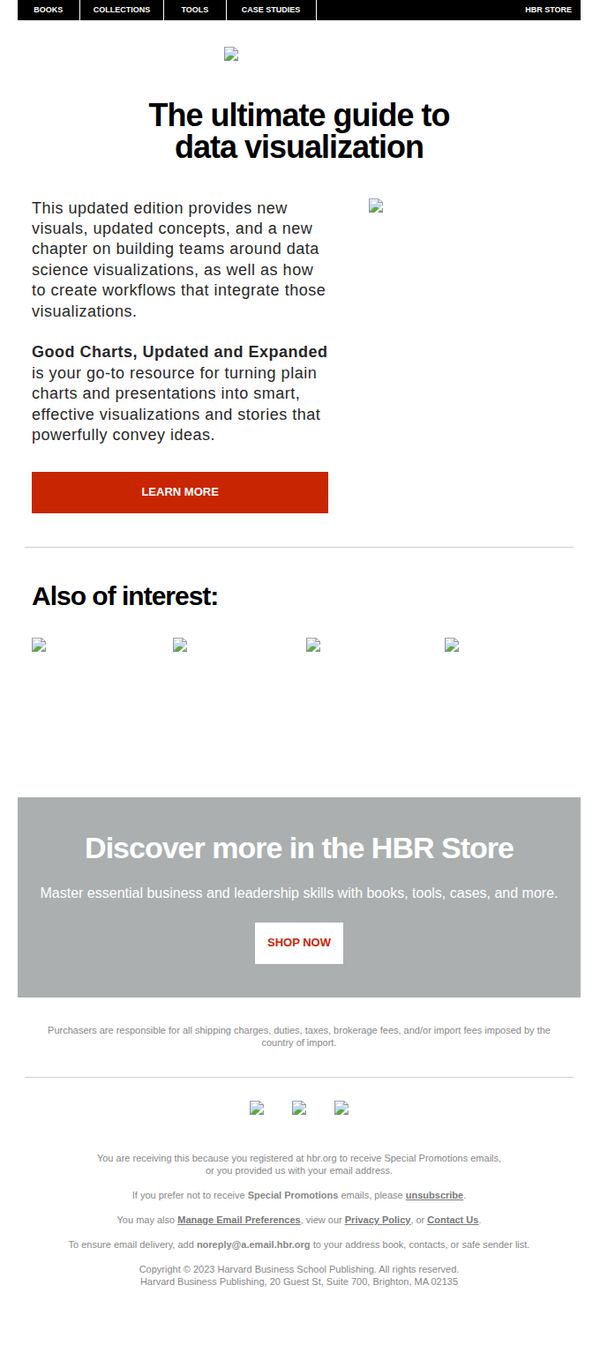

1. New and updated: The HBR guide to making smarter data visualizations.
Objective
This email aims to drive interest and conversions for the updated HBR guide on data visualization by highlighting its new content and practical value for professionals seeking to improve their storytelling with data. It also encourages broader exploration of HBR’s educational resources.
Why this works
The email effectively positions the updated guide as a must-have resource by emphasizing new visuals, expanded concepts, and a dedicated chapter on team workflows, making it feel timely, comprehensive, and immediately applicable to data-driven professionals.
How to implement
By framing the guide as a tool to transform plain charts into powerful stories, the copy taps into the emotional and professional desire to communicate more persuasively, which resonates deeply with managers and analysts who rely on data to influence decisions.
Pro Tip
Add a brief testimonial or quote from a recognized data visualization expert or past reader to build social proof and credibility around the guide’s value, especially since the target audience is likely skeptical of generic claims. • Include a visual thumbnail or mockup of the guide’s interior pages or sample charts to give recipients a tangible preview of the ‘new visuals’ mentioned, this would reduce ambiguity and increase perceived value before clicking.
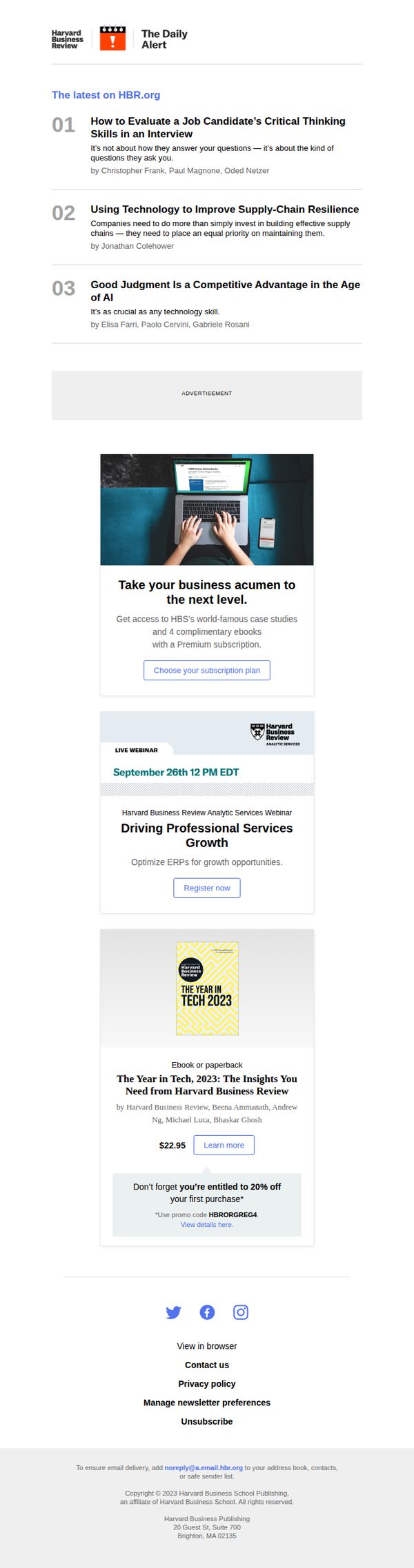
2. The Daily Alert
Objective
To deliver curated, high-value business insights to subscribers while subtly promoting HBR’s premium content, subscriptions, and events. The email aims to reinforce HBR’s authority and drive conversions through targeted offers and timely engagement.
Why this works
The email opens with a numbered, scannable list of top-tier articles that immediately signals value and authority, making it easy for busy professionals to identify relevant content without scrolling.
How to implement
Strategically placed promotional blocks, like the subscription offer and webinar registration, feel native to the content flow, blending editorial credibility with conversion intent without disrupting the reader’s experience.
Pro Tip
Add a visual progress indicator or 'read time' estimate next to each article to help readers prioritize content and increase perceived value through time-aware design. • Reposition the 'Register now' CTA for the webinar above the ebook promotion to prioritize live engagement over static content, leveraging F-pattern reading behavior for higher conversion.
3. Managing the Return: Preparing to Give Difficult Feedback
Objective
This email aims to guide managers through the emotional and strategic challenges of delivering difficult feedback by offering research-backed frameworks and relatable personal insights, ultimately encouraging readers to engage with HBR’s deeper content on leadership communication.
Why this works
The email opens with a vulnerable, first-person admission from the editor that immediately builds trust and signals this isn’t just theoretical advice, it’s battle-tested wisdom from someone who’s struggled with the same managerial dilemmas your audience faces daily.
How to implement
By weaving in expert quotes and research-backed frameworks, like Melody Wilding’s strategies and Chamorro-Premuzic and Clark’s three reasons for underperformance, the email elevates practical advice into credible, actionable leadership science without overwhelming the reader.
Pro Tip
Add a subtle visual cue, like a small icon or colored underline, to the 'Read more' CTAs to increase click visibility, since the current blue text blends too much with the body copy and lacks visual hierarchy. • Include a brief, bolded takeaway or one-sentence summary after each major section (e.g., 'Key Insight: Anticipating worst-case scenarios actually reduces anxiety and improves outcomes') to reinforce retention and cater to skimmers.
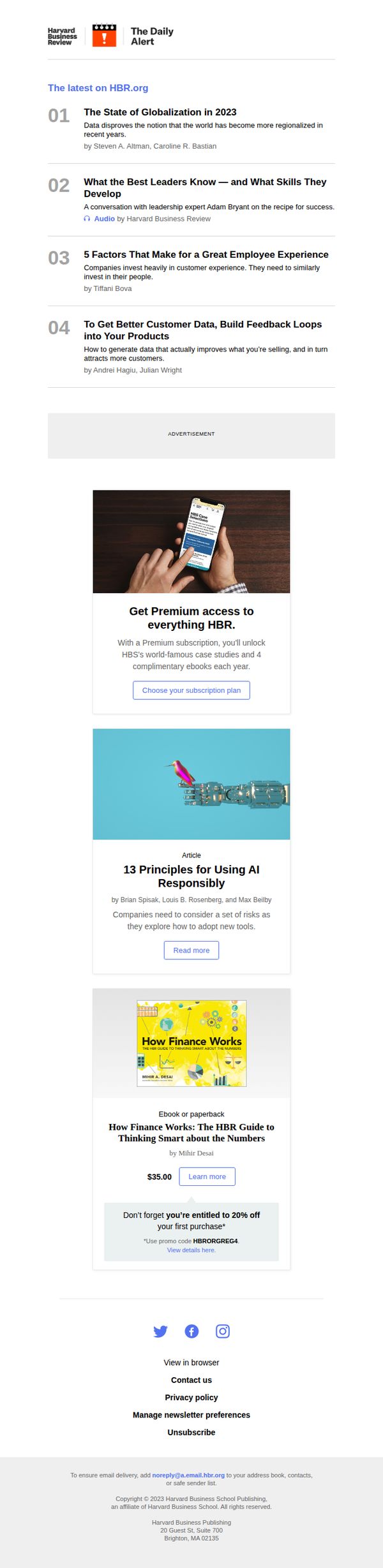
4. The Daily Alert
Objective
This email aims to drive engagement with HBR’s latest thought leadership content while converting readers into premium subscribers by highlighting high-value articles, audio features, and exclusive offers. It balances editorial value with commercial intent to nurture long-term reader loyalty and revenue.
Why this works
The email opens with a numbered, scannable list of top articles that immediately signals editorial authority and gives busy professionals a clear reason to keep reading, a smart way to hook time-poor decision-makers with credibility upfront.
How to implement
By embedding a premium subscription CTA directly after the editorial content, the email leverages reader momentum, turning intellectual curiosity into commercial intent at the exact moment when trust and interest are highest, which dramatically increases conversion likelihood.
Pro Tip
The subscription CTA is visually underwhelming, it lacks contrast and urgency. Adding a bold color, a countdown timer, or a badge like 'Most Popular Plan' would elevate its prominence and align visual hierarchy with the campaign’s conversion goal. • The email lacks social proof or testimonials near the subscription offer. Adding a short quote from a recognizable executive or a stat like '92% of subscribers say HBR changed their leadership approach' would strengthen trust and reduce perceived risk for new buyers.
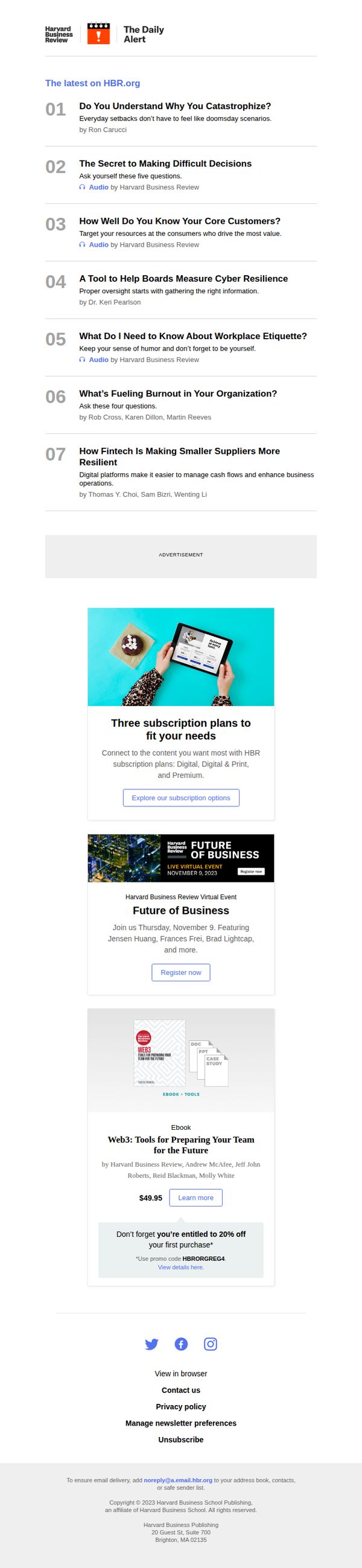
5. The Daily Alert
Objective
To deliver curated, high-value business insights to subscribers while subtly promoting HBR’s subscription plans, virtual events, and digital products. The email aims to reinforce thought leadership and drive conversions through relevance and authority.
Why this works
The email leverages a numbered, digest-style format that makes dense business content feel approachable and skimmable, encouraging readers to engage with multiple articles without feeling overwhelmed.
How to implement
Each article teaser pairs a provocative headline with a concise, benefit-driven subheading that answers the reader’s implicit question: ‘Why should I care?’, a powerful persuasion tactic for busy professionals.
Pro Tip
Add a subtle visual indicator (like a small badge or icon) next to articles with audio versions to increase engagement with multimedia content, especially for time-constrained readers. • Reposition the subscription CTA higher in the email, perhaps after the first 2–3 articles, to capture attention while interest is highest, rather than burying it after the content feed.
6. The latest research from Harvard Business Review Analytic Services
Objective
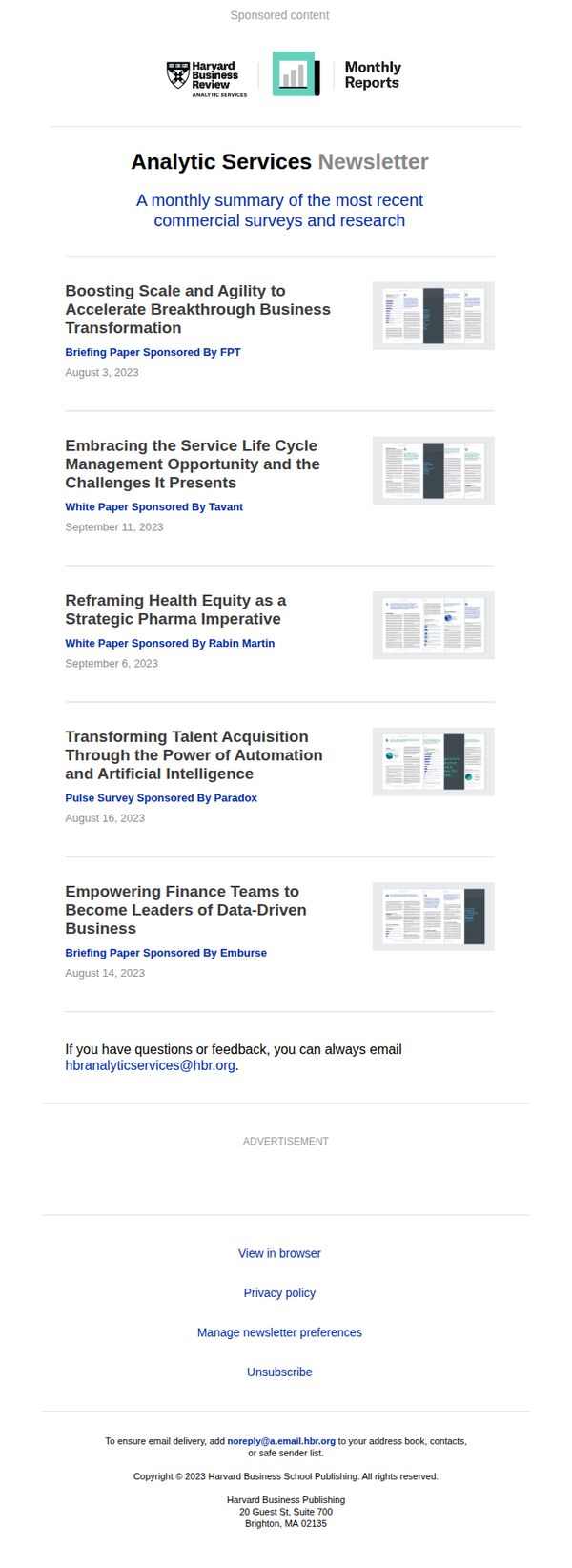
This email aims to position Harvard Business Review Analytic Services as a trusted source of cutting-edge, data-driven business insights by delivering a curated monthly digest of sponsored research reports to professionals seeking strategic decision-making tools.
Why this works
The email leverages the prestige of Harvard Business Review by prominently featuring sponsored research as authoritative industry intelligence, subtly aligning brand credibility with third-party content to enhance perceived value without overt sales pressure.
How to implement
Each research item is presented with a clear title, sponsor attribution, and publication date, creating a structured, scannable format that respects the reader’s time while signaling transparency and editorial integrity in sponsored content partnerships.
Pro Tip
Add a primary CTA button above the content list, such as 'Download the Latest Report', to drive immediate action, since the current 'View in browser' link is buried and doesn’t align with the goal of promoting research consumption. • Include a brief teaser or one-sentence value proposition under each report title to clarify why the reader should care, reducing cognitive load and increasing click-through by answering 'What’s in it for me?' upfront.
7. The Management Tip of the Day
Objective
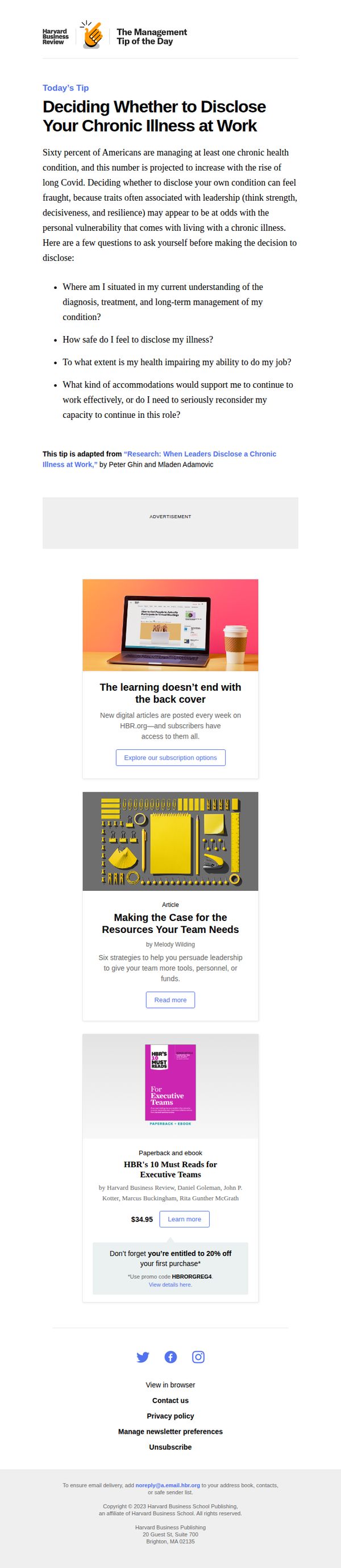
To deliver actionable, research-backed management advice that helps professionals navigate sensitive workplace decisions while subtly promoting HBR’s subscription and product offerings. The email positions HBR as a trusted authority on leadership and workplace well-being.
Why this works
The email opens with a deeply human, emotionally resonant topic, disclosing chronic illness at work, immediately establishing relevance and trust by addressing a real, under-discussed leadership challenge that many professionals face quietly.
How to implement
By anchoring the tip in credible research and citing the original authors, HBR reinforces its authority without sounding academic, making complex management concepts feel accessible, practical, and immediately applicable to the reader’s daily reality.
Pro Tip
Add a countdown timer or urgency cue near the 20% off promo to nudge immediate action, since the discount is time-sensitive and currently lacks visual emphasis to drive conversions. • Include a short testimonial or quote from a leader who benefited from disclosing their condition, to humanize the tip and strengthen emotional persuasion before the cross-sell section.
8. The Daily Alert
Objective
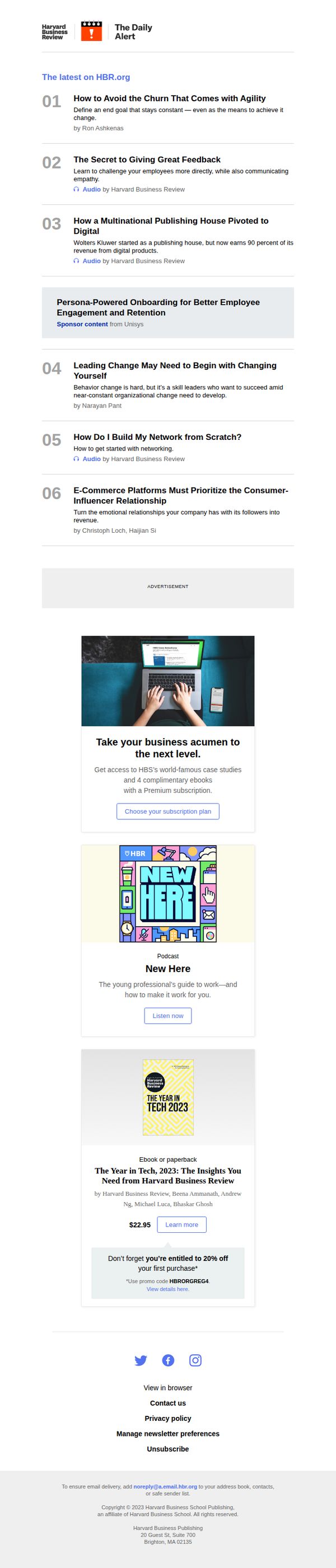
This email aims to deliver curated, high-value business insights to subscribers while subtly promoting premium content and subscriptions. It balances educational value with strategic product placement to nurture long-term reader loyalty and conversion.
Why this works
The email opens with a numbered, digest-style list of top articles that immediately signals value and saves the reader time, making it easy to skim while still feeling curated and authoritative.
How to implement
Strategically placing a sponsored content block mid-email maintains reader trust by clearly labeling it, while still integrating it naturally into the flow without disrupting the editorial tone or user experience.
Pro Tip
Add a visual progress indicator or 'You’re 3/6 articles in' counter near the top to gamify engagement and encourage readers to scroll through all content, increasing time-on-email and content consumption. • Reposition the 'Choose your subscription plan' CTA to appear after the first three articles, not after the ad, to capitalize on early reader interest before attention wanes or gets diverted by sponsored content.
9. The Management Tip of the Day
Objective
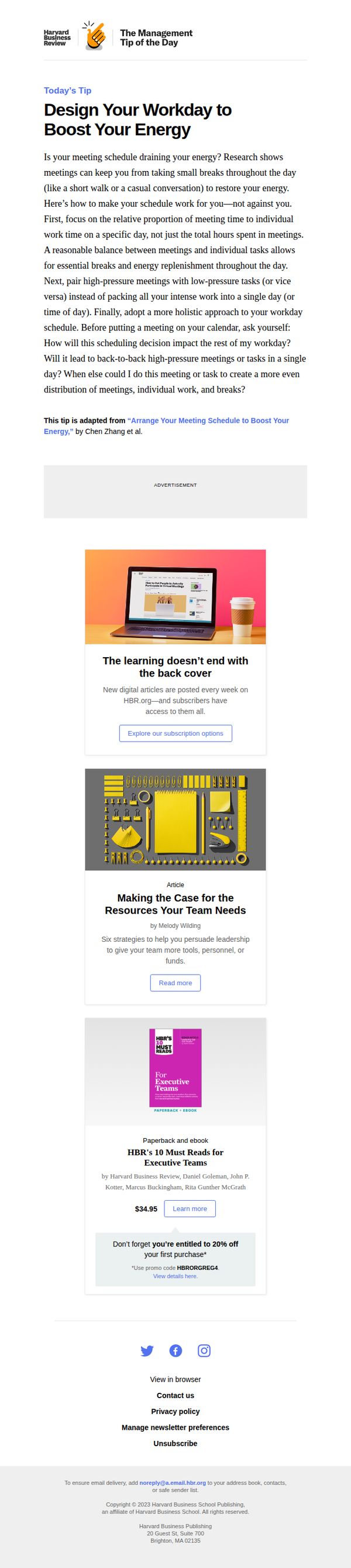
This email aims to deliver actionable, research-backed management advice to busy professionals while subtly promoting HBR’s subscription and product offerings. It positions HBR as a trusted daily resource for leadership development and productivity optimization.
Why this works
The email opens with a relatable pain point, energy-draining meetings, then immediately offers a research-backed, structured solution, making the advice feel both urgent and credible without overwhelming the reader.
How to implement
By anchoring the tip in a cited article and author, HBR reinforces its authority while creating a natural bridge to deeper content, encouraging readers to explore the source material or related offerings without feeling sold to.
Pro Tip
Add a secondary CTA button beneath the main tip, such as 'Save This Tip for Later' or 'Share With Your Team', to increase engagement and encourage social sharing without disrupting the primary conversion path. • Include a brief testimonial or user quote near the product promotion (e.g., '92% of readers who applied this tip reported better focus') to build social proof and reinforce the value of the advice before prompting a purchase.
10. Do you dread giving feedback?

Objective
This email aims to engage professionals who struggle with giving feedback by sharing a relatable personal story and offering actionable advice to reframe feedback as a growth opportunity. It encourages readers to reflect on their own feedback habits and explore HBR’s curated resources to build confidence and skill.
Why this works
The email opens with a vulnerable, first-person narrative that immediately resonates with readers who dread feedback, making the content feel personal and trustworthy rather than preachy or academic.
How to implement
By contrasting 'bad feedback' with 'good feedback' using concrete examples, the email transforms abstract advice into practical, memorable guidance that readers can immediately apply in their own workplaces.
Pro Tip
Add a secondary CTA button or link after the 'Recommended Reads' section that says 'Download the Feedback Playbook' or 'Get the 5-Step Feedback Framework' to capture readers who want immediate, actionable tools beyond articles. • Include a short, bolded takeaway or checklist (e.g., '3 Rules for Giving Feedback Without Fear') at the top of the email to give skimmers immediate value and increase retention of core principles.