Snowflake campaign emails worth copying
1. [Live Demo] Getting More From SAP Data with Snowflake
Objective
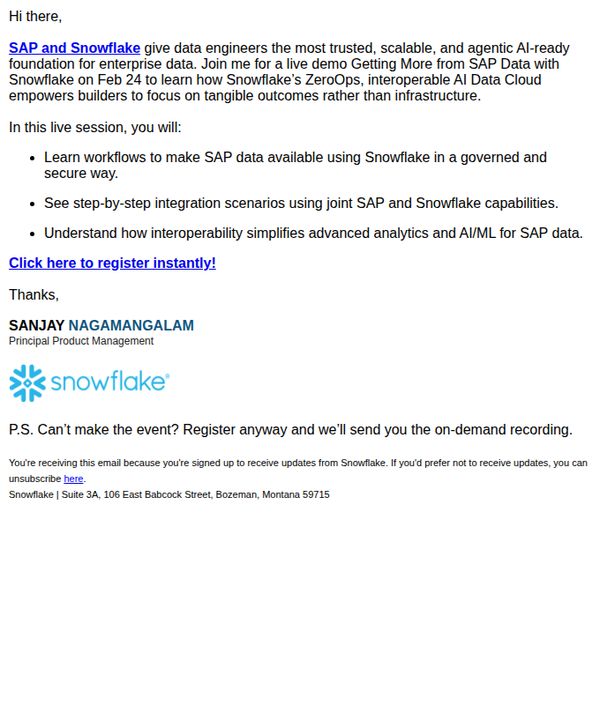
The email aims to drive registrations for a live demo showcasing how Snowflake enhances SAP data capabilities through ZeroOps and AI/ML integration, positioning Snowflake as a trusted, scalable platform for enterprise data engineers.
Why this works
The email smartly anchors its value proposition in a specific enterprise pain point, SAP data complexity, and positions Snowflake as the enabler of tangible outcomes, not just infrastructure, which resonates deeply with technical decision-makers.
How to implement
By listing three clear, outcome-driven bullet points, the email gives prospects a preview of exactly what they’ll gain from attending, reducing uncertainty and increasing perceived value without overwhelming them with technical jargon.
Pro Tip
Add a visual element like a short video thumbnail or animated GIF in the hero section to demonstrate Snowflake’s SAP integration in action, which would increase engagement and reduce cognitive load for technical audiences. • Include a brief testimonial or customer logo from an SAP-using enterprise near the CTA to build social proof and reinforce credibility, especially since the audience is likely evaluating vendor trustworthiness.
2. 2 Weeks Left to Register for BUILD — You In?
Objective
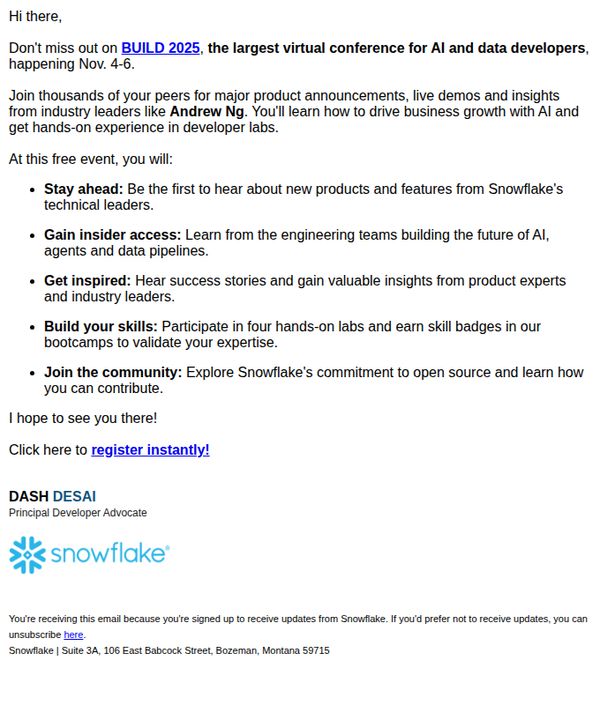
This email aims to drive last-minute registrations for Snowflake’s BUILD 2025 virtual conference by highlighting exclusive access to product announcements, expert-led sessions, and hands-on labs, all designed to motivate AI and data developers to act before the deadline.
Why this works
The email leverages urgency with a clear time-bound hook, '2 Weeks Left to Register', which immediately signals scarcity and prompts immediate action without overwhelming the reader with fluff or distractions.
How to implement
It strategically positions the event as a peer-driven, insider experience by emphasizing learning from 'engineering teams building the future of AI' and 'industry leaders like Andrew Ng,' which builds credibility and FOMO among technical audiences.
Pro Tip
Add a visual countdown timer or progress bar near the CTA to reinforce urgency and create a dynamic, time-sensitive nudge that’s more compelling than static text alone. • Include a short testimonial or quote from a past attendee to validate the event’s impact, this would strengthen social proof and reduce perceived risk for hesitant registrants.
3. Join me: Build Your Own Enterprise Intelligence Agent with Snowflake Intelligence
Objective
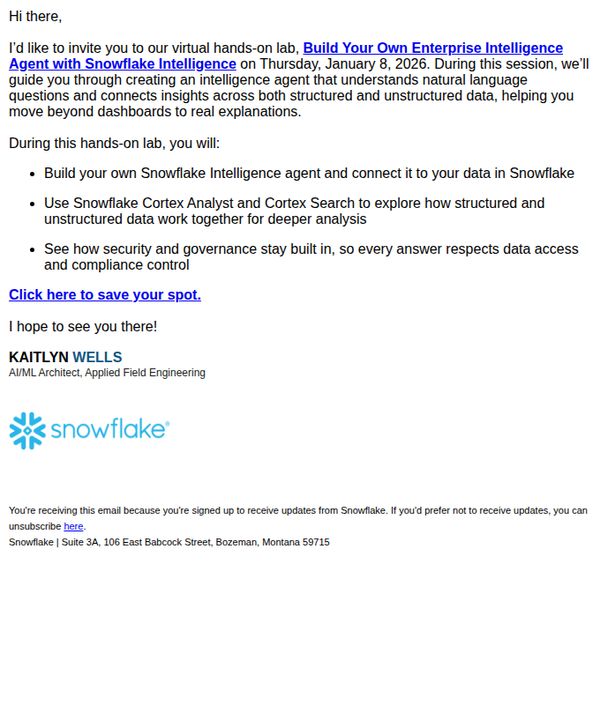
This email invites recipients to a virtual hands-on lab where they’ll build a custom enterprise intelligence agent using Snowflake Intelligence, aiming to demonstrate how natural language queries can unlock deeper insights from structured and unstructured data while maintaining security and governance.
Why this works
The email positions the lab as a personal invitation from a named expert, which builds trust and makes the experience feel exclusive rather than transactional, increasing the perceived value of attending.
How to implement
It clearly outlines three tangible outcomes attendees will achieve, building an agent, using Cortex tools, and seeing governance in action, which answers the ‘what’s in it for me’ question before the reader even asks it.
Pro Tip
Add a countdown timer or urgency indicator near the CTA to reinforce scarcity, since the event date is fixed and early registration likely improves attendance rates. • Include a short testimonial or quote from a past attendee to validate the lab’s value, especially since the audience may be skeptical about the ROI of a virtual technical session.
4. Join me: Building Your First Multimodal Document Pipeline
Objective
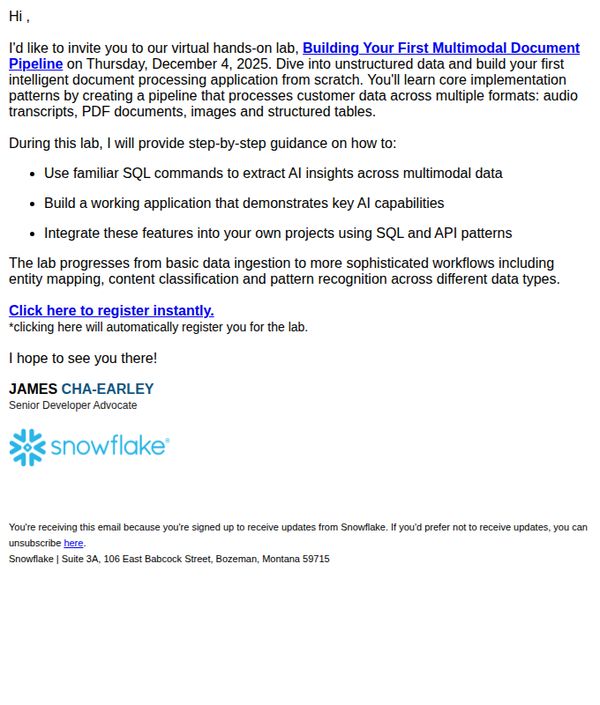
This email aims to drive registrations for a virtual hands-on lab where attendees will learn to build a multimodal document pipeline using Snowflake’s platform, targeting developers and data professionals interested in AI and SQL-based data processing.
Why this works
The email opens with a personal invitation from a named advocate, which builds trust and positions the event as a collaborative learning experience rather than a generic webinar, increasing perceived value and attendance intent.
How to implement
It clearly outlines the technical progression of the lab, from basic ingestion to advanced workflows, giving developers confidence they’ll gain tangible, scalable skills they can immediately apply to real-world projects.
Pro Tip
Add a visual element like a short video thumbnail or diagram of the pipeline architecture to break up text and visually reinforce the technical value proposition for visual learners. • Include a brief testimonial or quote from a past attendee to validate the lab’s effectiveness and reduce perceived risk for first-time participants.
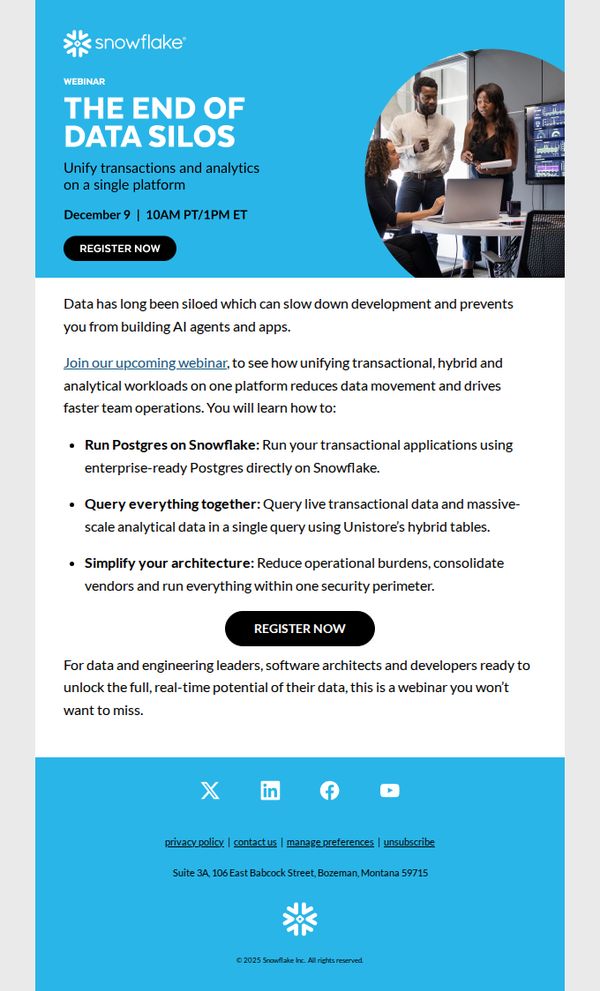
5. End the Data Divide: Unify Transactions and Analytics on Snowflake
Objective
This email aims to drive registrations for a Snowflake webinar that demonstrates how unifying transactional and analytical workloads on a single platform can accelerate development and AI initiatives. It targets data and engineering leaders by positioning Snowflake as the solution to data silos and operational complexity.
Why this works
The email opens with a bold, problem-centric headline, 'The End of Data Silos', that immediately resonates with technical leaders frustrated by fragmented systems, making the value proposition impossible to ignore.
How to implement
It strategically lists three concrete, benefit-driven takeaways using action verbs like 'Run,' 'Query,' and 'Simplify,' which translate technical capabilities into tangible business outcomes that appeal to both engineers and executives.
Pro Tip
Add a brief testimonial or customer result near the CTA to build social proof, for example, '90% of attendees reported faster time-to-insight after implementing unified workloads,' which would reinforce credibility and urgency. • Include a visual element like a mini architecture diagram or icon set next to the three bullet points to break up text and help technical readers quickly grasp the value of each feature without reading dense copy.
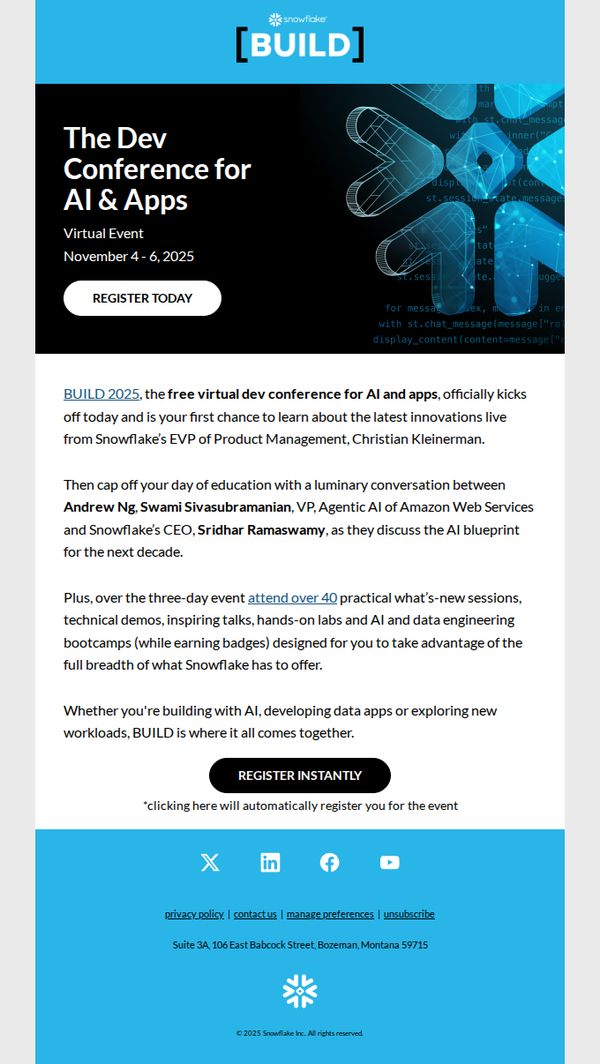
6. Join BUILD Keynote at 10 a.m. PT/1 p.m. ET — Andrew Ng at 3:30 p.m. PT / 6:30 p.m. ET
Objective
The email aims to drive immediate registrations for Snowflake’s virtual BUILD conference by highlighting keynote speakers, educational sessions, and the event’s relevance to AI and app developers. It positions the event as a must-attend for professionals seeking cutting-edge insights and hands-on learning.
Why this works
The email strategically anchors urgency and credibility by front-loading the keynote schedule with high-profile names like Andrew Ng and Snowflake’s CEO, making the event feel exclusive and time-sensitive without relying on artificial scarcity tactics.
How to implement
By clearly segmenting the value proposition, live keynotes, 40+ practical sessions, hands-on labs, and badge-earning opportunities, the email speaks directly to developer motivations: learning, credentialing, and community, which increases perceived ROI for attending.
Pro Tip
Add a visual countdown timer near the CTA to reinforce urgency, especially since the event starts today, this would leverage FOMO more effectively than text alone and align with the time-sensitive nature of the keynote schedule. • Include a short testimonial or quote from a past attendee or speaker to build social proof, since the email currently relies solely on speaker names and session counts without emotional or experiential validation.
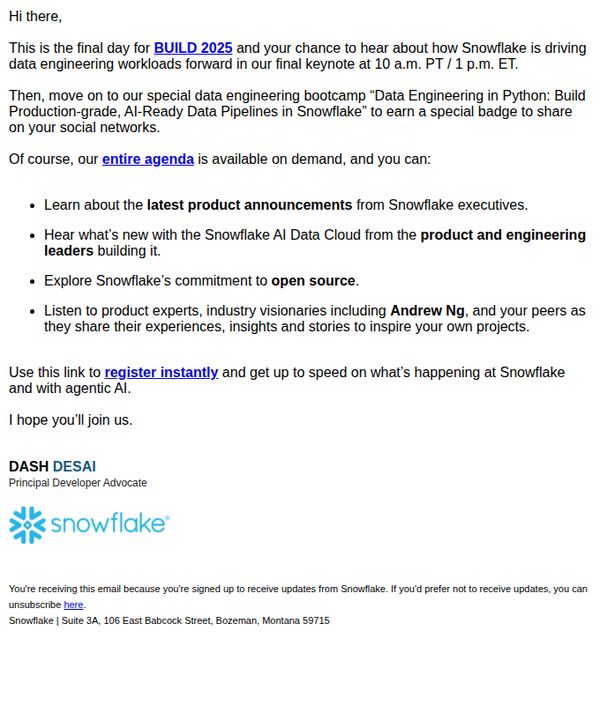
7. Final BUILD Keynote Starts Soon — Data Engineering Focused
Objective
This email aims to drive last-minute attendance to Snowflake’s final BUILD 2025 keynote by emphasizing its data engineering focus and exclusive content, while encouraging immediate registration through urgency and social proof from industry leaders.
Why this works
The email leverages time-sensitive urgency by calling it the 'final day' and 'final keynote,' which creates FOMO without being pushy, making it ideal for last-minute event promotions targeting technical audiences.
How to implement
It strategically highlights a niche, high-value session, 'Data Engineering in Python', to speak directly to a specific persona, increasing relevance and conversion by aligning content with the recipient’s professional identity.
Pro Tip
Add a visual countdown timer or 'Live Now' badge near the CTA to reinforce urgency and reduce friction for users deciding whether to click immediately. • Include a short testimonial or quote from a past attendee about the value of the keynote or bootcamp to strengthen social proof and reduce perceived risk for first-time registrants.
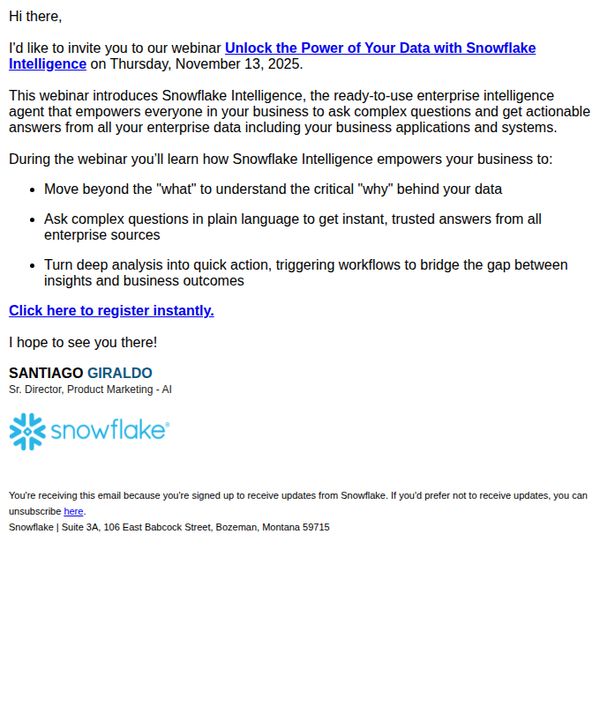
8. Join me: Unlock the Power of Your Data with Snowflake Intelligence
Objective
This email aims to drive registrations for a Snowflake webinar by highlighting how Snowflake Intelligence empowers business users to ask complex questions and turn insights into action. It positions the tool as accessible and transformative for enterprise decision-making.
Why this works
The email brilliantly frames Snowflake Intelligence not as a technical tool but as an empowering agent for non-technical users, making enterprise data feel accessible and actionable to everyone in the business.
How to implement
By focusing on outcomes, turning deep analysis into quick action and bridging the gap between insights and business outcomes, the message speaks directly to decision-makers’ desire for tangible ROI from data investments.
Pro Tip
Add a brief testimonial or customer result near the CTA to reinforce social proof, seeing a peer’s success with Snowflake Intelligence could reduce hesitation and boost conversion. • Include a subtle visual hierarchy or bullet-point icons to break up the dense text in the benefits section, improving scannability and helping busy readers absorb value quickly.
9. [Webinar] Building Your First Multimodal Document Pipeline
![9. [Webinar] Building Your First Multimodal Document Pipeline](https://nudge-growth-experimental.s3.amazonaws.com/nudge/email-screenshots/4235929.jpg)
Objective
This email aims to drive registrations for a virtual hands-on lab webinar where attendees will learn to build a multimodal document pipeline using Snowflake’s platform, targeting technical users interested in AI and unstructured data processing.
Why this works
The email clearly positions the webinar as a practical, step-by-step lab experience rather than a passive lecture, which appeals to developers and data engineers who value actionable, buildable outcomes over theoretical concepts.
How to implement
By explicitly listing what attendees will build, such as using SQL to extract AI insights from audio, PDFs, and images, the email creates tangible value and reduces perceived risk for time investment, increasing conversion likelihood.
Pro Tip
Add a brief testimonial or quote from a past attendee near the CTA to build social proof and reinforce credibility, especially since the audience is technical and may seek validation before committing time. • Include a short countdown timer or note like 'Seats are limited' near the CTA to create urgency, as the current design lacks any time-sensitive pressure that could boost immediate registration.
10. BUILD AI Keynote at 10 a.m. PT/1 p.m. ET — Don’t Miss It
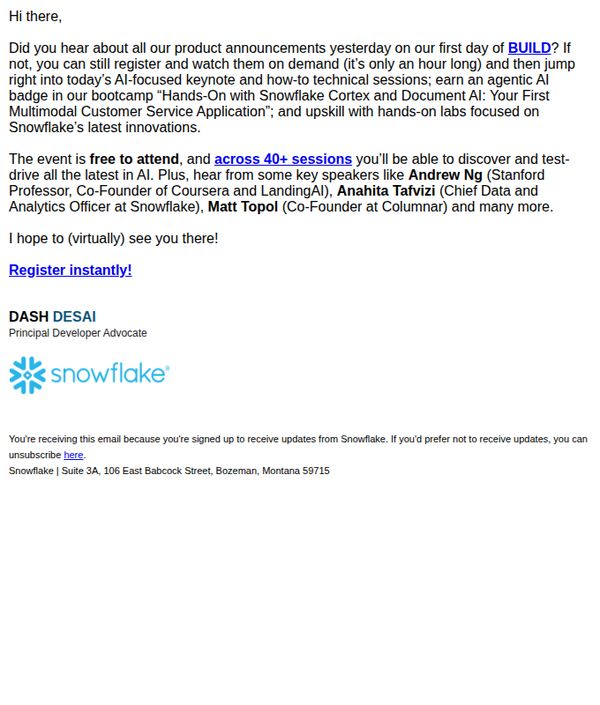
Objective
To drive immediate registration for Snowflake’s BUILD AI Keynote by highlighting time-sensitive access to product announcements, expert speakers, and hands-on learning opportunities, while reinforcing the event’s value as a must-attend for AI and data professionals.
Why this works
The email creates urgency by emphasizing the event’s live timing and limited on-demand window, which taps into FOMO while still offering flexibility for busy professionals who can’t attend live.
How to implement
It strategically name-drops high-profile speakers like Andrew Ng and Anaconda Tafvizi to lend credibility and attract niche audiences who follow these thought leaders, increasing perceived value and conversion likelihood.
Pro Tip
Add a visual countdown timer near the CTA to reinforce urgency and reduce cognitive load, users shouldn’t have to mentally calculate time zones or session duration to feel compelled to act. • Include a short testimonial or quote from a past attendee about the value of BUILD sessions to build social proof, especially since the email relies heavily on speaker names rather than attendee outcomes.