The Economist emails worth copying




1. Inside Norway’s spytown
Objective
This email aims to engage readers with a gripping espionage narrative from Norway while subtly encouraging subscription by showcasing the depth and global reach of The Economist’s long-form journalism. It also promotes additional content and exclusive subscriber offerings to deepen audience loyalty.
Why this works
The email opens with a cinematic, real-life spy story that immediately hooks the reader by blending geopolitical intrigue with human vulnerability, a masterclass in using narrative tension to drive engagement before any sales pitch appears.
How to implement
By placing the subscription CTA directly beneath the article’s emotional climax, the campaign leverages peak reader investment to convert curiosity into commitment, making the ask feel like a natural next step rather than an interruption.
Pro Tip
The subscription CTA could be strengthened by adding social proof, such as 'Join 1.5M+ global readers', to increase perceived value and reduce hesitation, especially since the offer is priced in Philippine pesos, which may confuse non-local audiences. • The 'Also from 1843 magazine' and 'From the archive' sections lack visual hierarchy; adding subtle badges like 'Editor’s Pick' or 'Most Read' would guide attention and increase click-through by signaling editorial curation rather than just random placement.
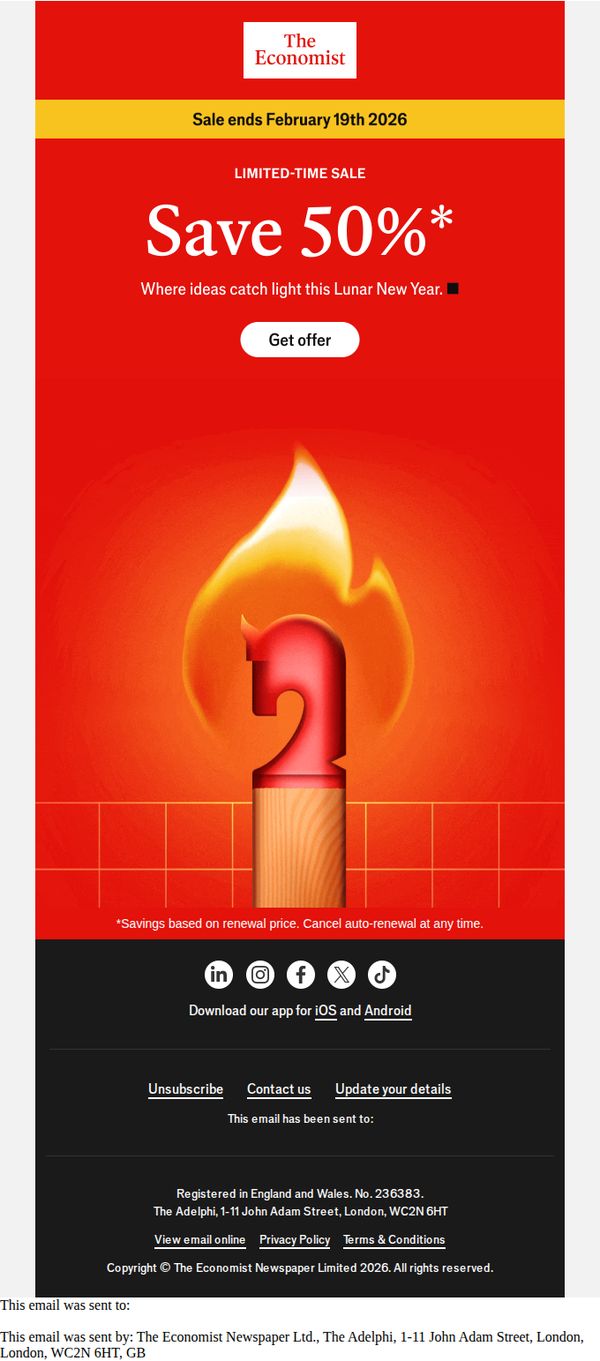
2. Lunar New Year sale: save on The Economist
Objective
The email aims to drive immediate subscriptions by leveraging the Lunar New Year cultural moment with a time-sensitive 50% discount, encouraging readers to act before the February 19th deadline while reinforcing The Economist’s brand as a source of illuminating ideas.
Why this works
The email brilliantly ties a cultural milestone, Lunar New Year, to intellectual value by framing the subscription as ‘where ideas catch light,’ transforming a discount into a symbolic gift of insight rather than just a price cut.
How to implement
Using a bold, flame-shaped ‘2’ as the central visual metaphor not only reinforces the 50% savings but also subtly evokes celebration and urgency, making the offer feel both festive and fleeting without relying on clichéd imagery.
Pro Tip
Add a brief testimonial or subscriber quote near the CTA to build social proof, for example, ‘Join 1.5M readers who start their week with The Economist’, to reduce perceived risk and increase trust in the offer’s value. • Include a small countdown timer beneath the ‘Sale ends February 19th 2026’ banner to visually reinforce urgency, as static text alone may not trigger the same psychological response as a dynamic, ticking deadline.
3. How to form good habits (and break bad ones)
Objective
This email aims to engage subscribers with curated, high-value journalism while subtly encouraging subscription through a strategically placed trial offer. It balances intellectual content with conversion by positioning The Economist as an essential source for understanding complex global issues.
Why this works
The email opens with a psychologically compelling hook, how to form good habits, immediately tying personal development to neuroscience, which primes readers to see The Economist as a source of actionable, brain-based insight rather than just news.
How to implement
By embedding the subscription CTA within a visually distinct blue banner after the first major article, the campaign leverages reader momentum, converting curiosity into action without interrupting the editorial flow or feeling overly salesy.
Pro Tip
The CTA 'Start your free trial today' lacks urgency or specificity, adding a time-bound incentive like 'Limited-time access to all premium analysis' would strengthen conversion by reducing perceived risk and increasing perceived value. • The podcast section featuring Trump is visually isolated and lacks a clear link to the main content theme; integrating it with a headline like 'Why this week’s podcast matters for understanding political risk' would better align it with the email’s intellectual positioning.
4. Assassinations abroad are getting more brazen
Objective
This email aims to engage readers with curated, high-impact global news stories while subtly encouraging subscription through a mid-content promotional banner. It balances journalistic depth with strategic monetization by showcasing The Economist’s editorial range and authority.
Why this works
The email masterfully blends hard-hitting geopolitical headlines with unexpected science and culture stories, creating a rhythm that keeps readers scrolling while reinforcing the brand’s intellectual breadth and editorial curation.
How to implement
By embedding the subscription CTA within the content flow rather than relegating it to the footer, the campaign leverages reader momentum, turning curiosity into conversion without interrupting the narrative experience.
Pro Tip
The subscription CTA could be more persuasive by adding social proof, such as 'Join 1.5 million readers worldwide', to reinforce credibility and reduce perceived risk for new subscribers. • The 'Figure of the Day' section lacks visual emphasis; adding a subtle border or background color would help it stand out as a digestible data snack, increasing its likelihood of being read and shared.
5. The war against PDFs is heating up
Objective
The email aims to engage subscribers with curated daily journalism while promoting app adoption and a limited-time subscription discount, blending editorial value with conversion-driven marketing to strengthen reader loyalty and revenue.
Why this works
The email masterfully balances editorial depth with commercial intent by embedding a compelling discount offer within a richly curated content digest, making the promotion feel like a natural extension of the reader’s daily ritual rather than an interruption.
How to implement
By leading with a provocative, AI-related headline about PDFs, a universally relatable pain point, the campaign immediately hooks tech-savvy and professional readers, then leverages that curiosity to funnel them toward app downloads and subscription upgrades.
Pro Tip
The 'Get offer' CTA button lacks visual hierarchy, it should be larger, more colorful, or positioned above the fold to compete with the editorial content and reduce the risk of being overlooked by skimming readers. • The 'Editor’s picks' section could benefit from a brief editorial rationale or curator note for each article to increase perceived authority and guide readers toward high-value content, rather than relying solely on headlines and thumbnails.
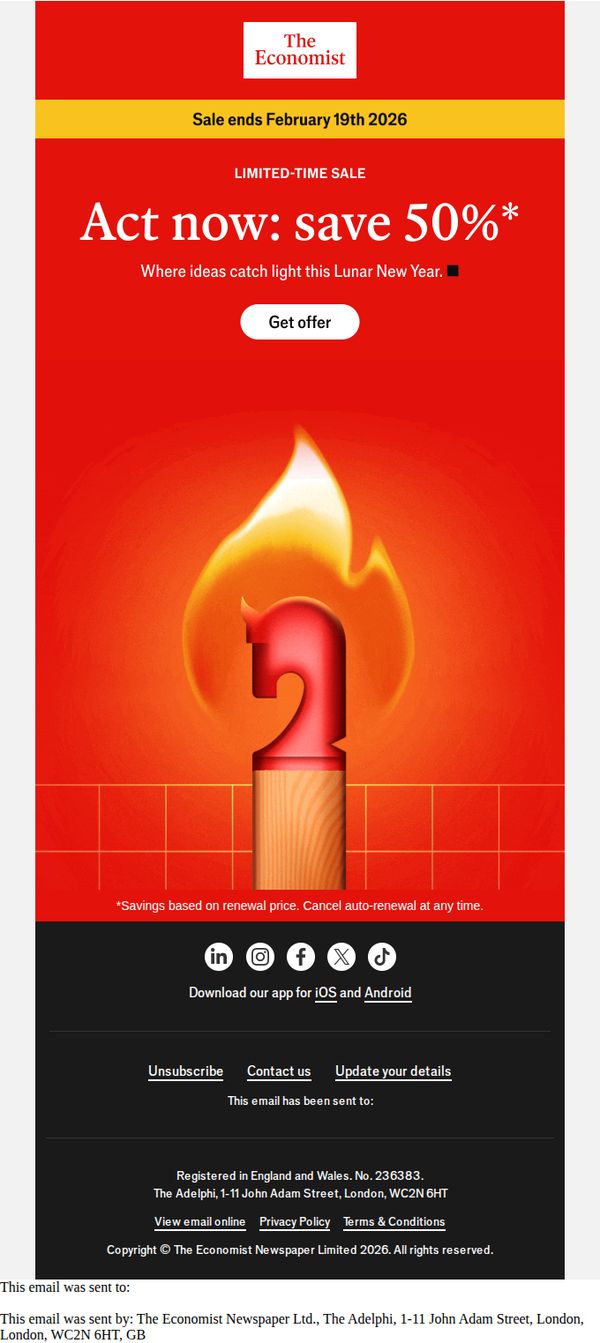
6. Act now: save this Lunar New Year
Objective
The email aims to drive immediate subscription conversions by leveraging the Lunar New Year timing with a limited-time 50% discount, creating urgency while aligning the brand’s intellectual tone with festive symbolism.
Why this works
The email brilliantly ties a cultural moment, Lunar New Year, to a rational value proposition, using the candle numeral '2' to symbolize both the year and the idea of enlightenment, making the discount feel intellectually earned rather than merely promotional.
How to implement
By anchoring the offer to a specific end date, February 19th, 2026, and pairing it with a bold red-and-gold palette, the campaign creates visual urgency while staying true to the brand’s sophisticated aesthetic, avoiding cheap sales tropes.
Pro Tip
Add a brief testimonial or subscriber quote near the CTA to reinforce social proof, for a brand like The Economist, a line like 'Join 1.5M readers who start their week informed' would strengthen credibility without cluttering the design. • Include a small, non-intrusive countdown timer beneath the 'Sale ends February 19th 2026' banner to amplify urgency visually, especially since the date is far in the future and may not feel immediately pressing to recipients.
7. Join us at Sustainability Week: Countdown to COP28

Objective
This email aims to drive registrations for The Economist Impact’s Sustainability Week event by highlighting its hybrid format, high-profile speakers, and exclusive discount, while positioning it as an essential preparatory guide for COP28.
Why this works
The email effectively leverages credibility by listing high-profile executives and policymakers from major global brands, which reassures potential attendees that the event offers authoritative, actionable insights rather than generic sustainability chatter.
How to implement
By clearly separating delegate and VIP pass options with distinct pricing, access levels, and CTAs, the email reduces decision fatigue and guides users toward the most appropriate registration path based on their professional standing or budget.
Pro Tip
Add a visual countdown timer near the CTA to reinforce urgency around limited in-person seats and the October 2nd start date, which would increase perceived scarcity and drive faster registrations. • Include a short testimonial or quote from a past attendee or speaker to build social proof, especially since the email relies heavily on speaker credentials but lacks real-world validation of the event’s value.
8. Why American house prices keep rising

Objective
To engage readers with a curated selection of top global stories while driving subscriptions through a prominently placed offer. The email positions The Economist as an essential daily source for incisive, independent journalism on complex global issues.
Why this works
The email masterfully balances editorial depth with commercial intent by embedding a subscription CTA within a rich narrative flow, making the pitch feel like a natural extension of the content rather than an interruption.
How to implement
Each story is teased with a compelling visual and a provocative subheadline that hints at deeper analysis, effectively leveraging curiosity and urgency to drive clicks without resorting to sensationalism or clickbait tactics.
Pro Tip
The subscription CTA appears only once and is visually buried beneath multiple article teasers; adding a sticky or repeated CTA near the top and bottom of the email would improve conversion by reducing scroll fatigue and reinforcing the offer at key decision points. • The email lacks personalization cues, such as the reader’s name or region-specific content, which could increase engagement by making the content feel more relevant and tailored to individual interests or geographic context.
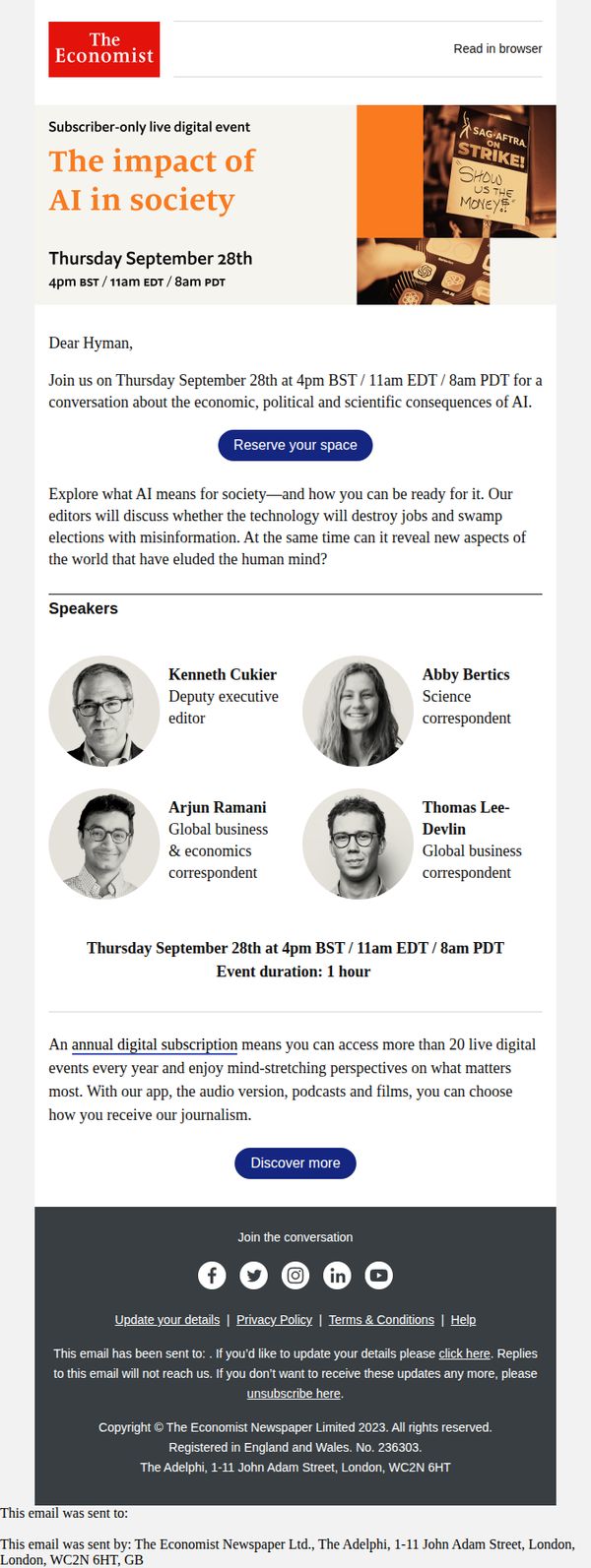
9. An exclusive invite to a live digital event: "The impact of AI in society"
Objective
The email aims to drive subscriber attendance to an exclusive live digital event hosted by The Economist, focusing on AI’s societal impact, while subtly reinforcing the value of a paid digital subscription through event access and additional content perks.
Why this works
The email leverages exclusivity by framing the event as subscriber-only, which elevates perceived value and taps into FOMO without sounding pushy, making the invitation feel like a privilege rather than a pitch.
How to implement
By spotlighting high-caliber editors as speakers with clear titles and headshots, the email builds instant credibility and intellectual authority, reassuring recipients that the conversation will be substantive, not superficial.
Pro Tip
Add a countdown timer near the CTA to create urgency, since the event date is fixed and proximity can motivate faster registration, especially for time-sensitive audiences. • Include a short teaser quote or preview insight from one of the speakers to spark curiosity and give recipients a tangible reason to believe the conversation will be worth their time.
10. The chaos in Washington has global consequences

Objective
This email aims to drive subscriptions by showcasing The Economist’s daily curation of globally significant news, while subtly reinforcing the urgency of staying informed amid political and economic instability in Washington. It blends editorial authority with a direct, value-driven subscription offer.
Why this works
The email opens with a powerful headline that ties domestic U.S. chaos to global consequences, immediately signaling relevance to an international audience who rely on The Economist for geopolitical context beyond American borders.
How to implement
By embedding the subscription CTA within a visually distinct blue banner after the first article, the campaign strategically interrupts the reader’s scroll with a high-contrast conversion prompt without disrupting editorial flow or perceived credibility.
Pro Tip
Add a countdown timer or limited-time discount indicator next to the P60/week offer to create urgency, since the current CTA lacks temporal pressure despite the headline’s emphasis on ‘chaos’ and ‘turbulent times.’ • Include a short testimonial or subscriber quote near the CTA, perhaps from a global business leader or policymaker, to humanize the value proposition and reinforce trust before the reader reaches the footer.