Toast email gallery from real brands
1. Ready when you are!
Objective
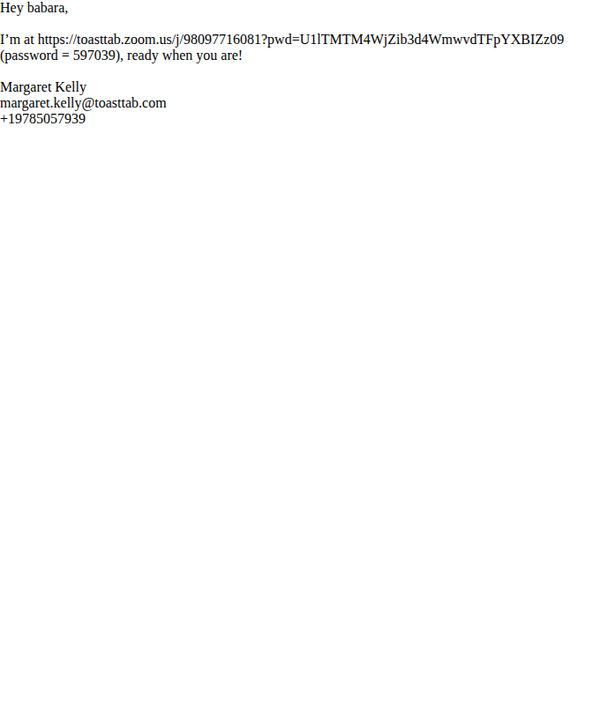
This email aims to schedule a personalized Zoom meeting with the recipient to demonstrate Toast’s restaurant management platform, leveraging personal outreach to drive engagement and conversion.
Why this works
The email opens with a warm, personalized greeting that immediately establishes a human connection, making the recipient feel seen and valued rather than targeted by automation.
How to implement
Including the direct Zoom link and password in the body removes friction and reduces the chance of drop-off, demonstrating a thoughtful understanding of user behavior and decision fatigue.
Pro Tip
Add a brief 1–2 sentence value proposition before the Zoom link to clarify why the meeting matters, for example, 'See how Toast can cut your labor costs by 15% in 15 minutes.' • Include a secondary CTA like 'Reschedule if this time doesn’t work' with a Calendly link to reduce friction for recipients who are interested but unavailable.
2. Babara- Next Steps with Toast POS
Objective
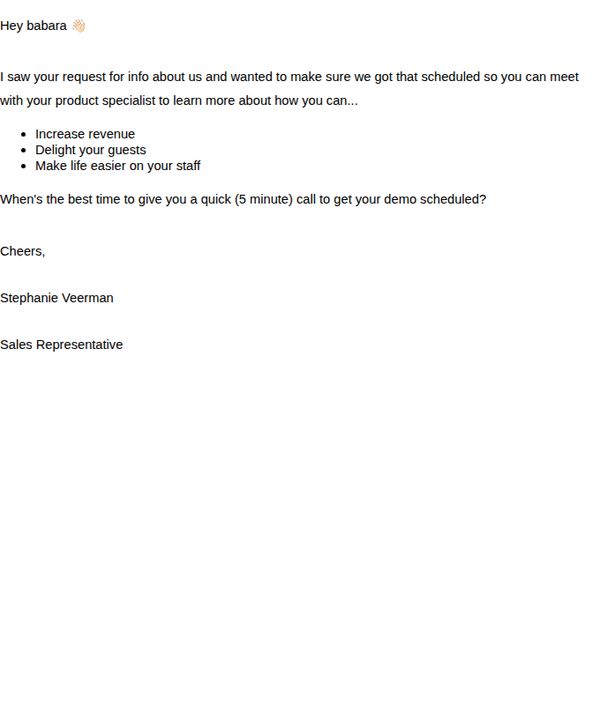
This email aims to convert a warm lead into a scheduled product demo by highlighting key business benefits and prompting immediate action through a personalized, low-pressure call-to-action.
Why this works
The email opens with a warm, personalized greeting that immediately acknowledges the recipient’s prior interest, creating a sense of continuity and trust that encourages engagement.
How to implement
It strategically frames the product’s value around three tangible business outcomes, revenue growth, guest satisfaction, and staff efficiency, making the benefits instantly relatable to restaurant operators.
Pro Tip
Add a subtle visual hierarchy or bullet point styling to the three benefits to make them more scannable and visually distinct, helping busy restaurant owners absorb value quickly. • Include a brief testimonial or social proof near the CTA, such as '87% of restaurants saw faster checkout times within 2 weeks', to reinforce credibility and reduce perceived risk.
3. Reminder: meeting tomorrow!
Objective
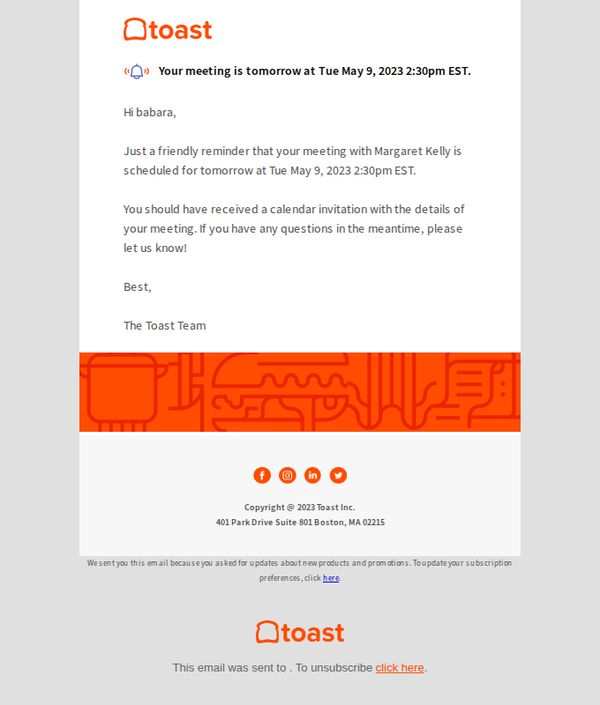
This email serves as a polite, last-minute reminder to ensure the recipient is aware of an upcoming meeting scheduled for the next day, reinforcing attendance and offering support for any questions.
Why this works
The email opens with a clear, time-sensitive subject line and visual alert icon to immediately signal urgency without sounding pushy, which helps recipients prioritize the message in a busy inbox.
How to implement
By personalizing the greeting and referencing the recipient’s specific meeting details, the email builds trust and reduces friction, making the recipient feel individually acknowledged rather than mass-emailed.
Pro Tip
Add a direct calendar add-to-calendar button or link beneath the meeting time to reduce friction and increase the likelihood of the recipient saving the event immediately. • Include a brief bullet-point summary of meeting agenda or goals to help the recipient prepare, increasing perceived value and reducing last-minute cancellations or no-shows.
4. Confirmed! Can't wait to learn more about Barbara Restau
Objective
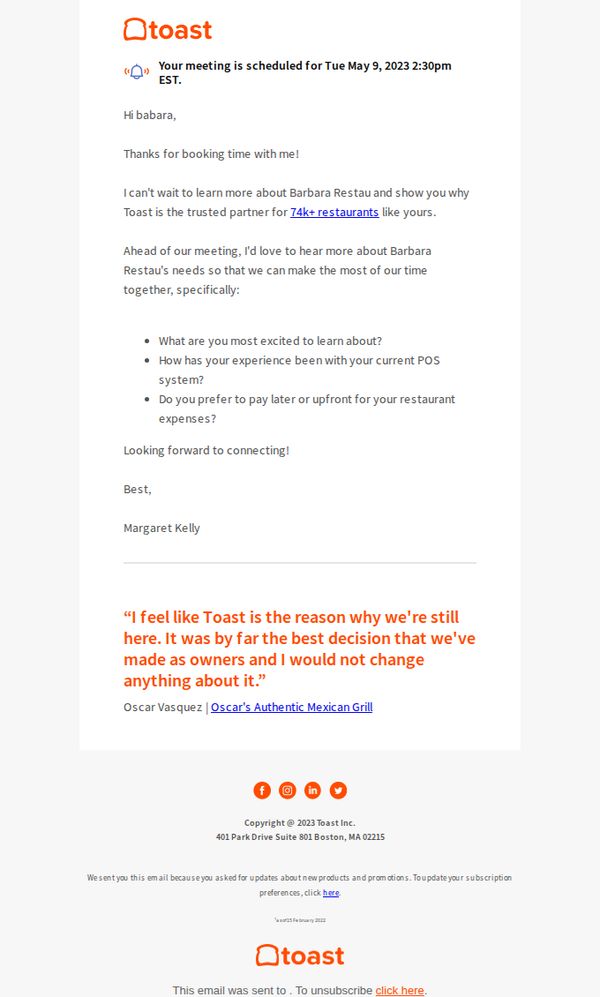
This email confirms a scheduled meeting with a restaurant owner and aims to build anticipation by personalizing the upcoming conversation around their specific needs and preferences, while reinforcing Toast’s credibility through social proof.
Why this works
The email opens with a warm, personalized tone that immediately validates the recipient’s decision to engage, making them feel seen and valued before diving into logistical details or sales pitches.
How to implement
Including a curated list of pre-meeting questions not only sets clear expectations but also subtly guides the prospect to reflect on their pain points, priming them for a more productive and solution-focused conversation.
Pro Tip
Add a visual cue or icon next to the meeting time to make the date and time more scannable and reduce cognitive load for busy restaurant owners who may skim the email quickly. • Include a brief, one-sentence value preview of what the prospect will gain from the meeting, such as 'You’ll walk away with 3 tailored ways Toast can cut your labor costs', to increase perceived relevance and urgency.
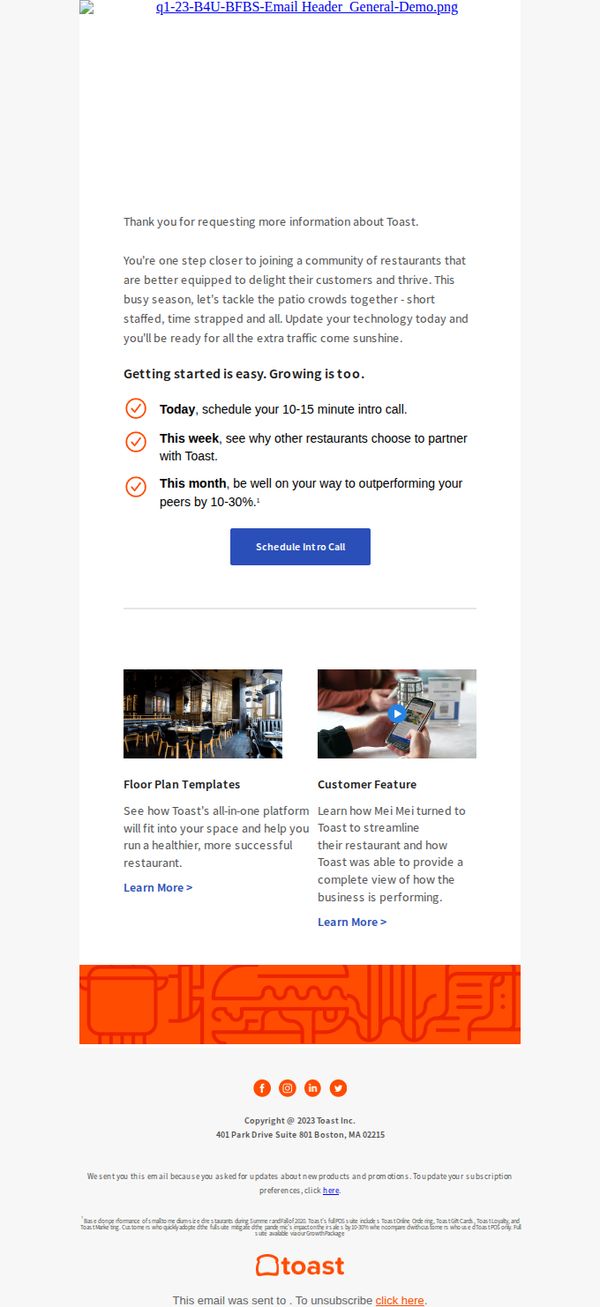
5. [Request Received] Let's get ready for Busy Season
Objective
This email aims to convert a lead who requested more information into a scheduled intro call by positioning Toast as the essential tech partner for restaurants preparing for peak season, emphasizing ease of onboarding and measurable growth outcomes.
Why this works
The email frames the busy season as a shared challenge rather than a sales pitch, building empathy by acknowledging real restaurant pain points like short staffing and time pressure, which instantly creates relevance for the reader.
How to implement
By breaking the onboarding journey into three time-bound milestones, today, this week, this month, the email reduces perceived friction and creates a clear, achievable path forward that aligns with the prospect’s urgency and planning cycle.
Pro Tip
Add a subtle countdown timer or urgency indicator near the CTA to reinforce the ‘busy season’ context and nudge immediate action, since the current design lacks time-sensitive pressure despite referencing seasonal urgency. • Reposition the two content blocks (Floor Plan Templates and Customer Feature) above the CTA to prime the prospect with value before asking for commitment, improving conversion flow by building credibility before the ask.
6. Invitation: Barbara Restau | Toast POS Demonstration [Online] @ Tue May 9, 2023 2:30pm - 3:30pm (EDT) (babarabernhard6792@njaemail.com)
![6. Invitation: Barbara Restau | Toast POS Demonstration [Online] @ Tue May 9, 2023 2:30pm - 3:30pm (EDT) (babarabernhard6792@njaemail.com)](https://nudge-growth-experimental.s3.amazonaws.com/nudge/email-screenshots/652516.jpg)
Objective
This email aims to confirm and prepare the recipient for an upcoming online demonstration of the Toast POS system by outlining the agenda, providing clear access instructions, and encouraging timely attendance through a simple RSVP mechanism.
Why this works
The email immediately builds trust by personalizing the recipient’s name and assigning a dedicated representative, which transforms a generic demo into a tailored, one-on-one experience that feels exclusive and professionally managed.
How to implement
By clearly listing the meeting agenda upfront, including intro, live demo, and pricing, the email reduces uncertainty and primes the prospect to engage actively, knowing exactly what value they’ll receive in the allotted time.
Pro Tip
Add a visual countdown timer or bolded 'Time Remaining' indicator near the top to create urgency and reduce no-shows, especially since the meeting is scheduled for a specific time and requires active participation. • Include a brief 1-2 sentence testimonial or social proof from a similar restaurant owner who benefited from Toast POS, placed just before the RSVP buttons, to reinforce credibility and motivate attendance.
7. Barbara Restau, get ready to meet with Toast
Objective
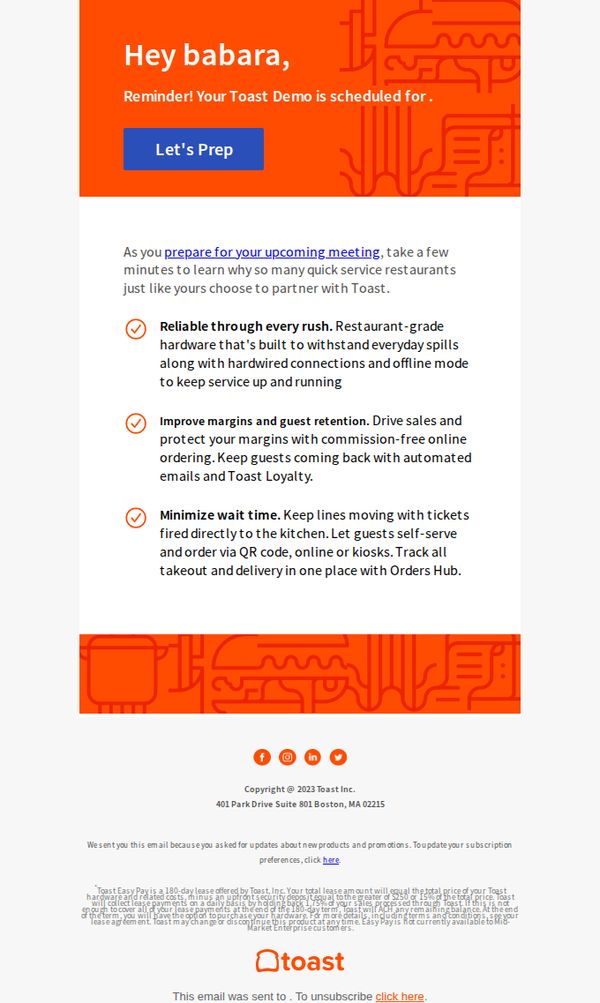
This email aims to remind Barbara Restau of her upcoming Toast demo and encourage her to prepare by highlighting key benefits that align with restaurant operational needs, thereby increasing engagement and conversion ahead of the meeting.
Why this works
The email opens with a personalized greeting and urgent reminder, creating immediate relevance and ownership for the recipient, which increases the likelihood they’ll engage before the scheduled demo.
How to implement
Each benefit is framed as a solved pain point, reliability during rushes, margin protection, and wait time reduction, making the value proposition instantly relatable and emotionally compelling for restaurant operators.
Pro Tip
Add a countdown timer or calendar reminder link near the CTA to reinforce urgency and help Barbara schedule prep time, increasing the likelihood she’ll act before the demo. • Include a short testimonial or case study snippet from a similar restaurant to build social proof and reduce perceived risk, especially since this is a pre-demo reminder targeting decision-makers.
8. Hi babara, looks like you're already a Toast customer.
Objective
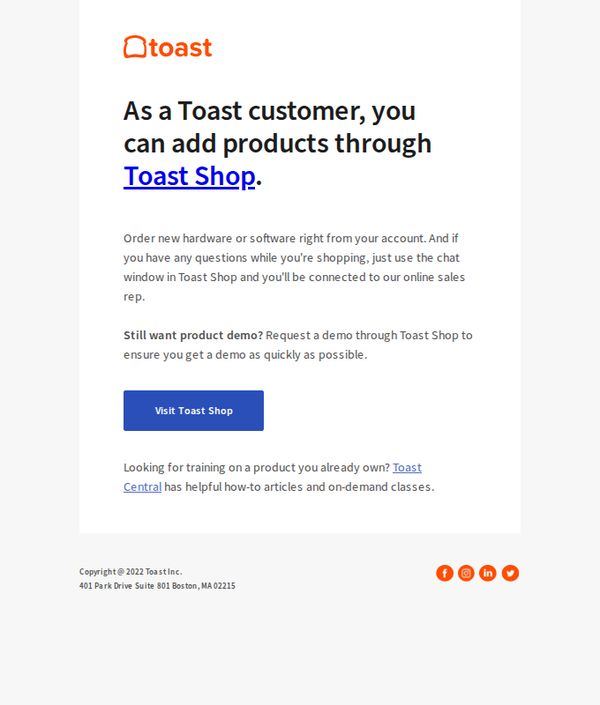
This email aims to re-engage existing Toast customers by guiding them to Toast Shop for seamless product additions and demos, while also directing them to Toast Central for training resources to maximize product value.
Why this works
The email opens with personalized recognition of the recipient’s existing customer status, which builds trust and reduces friction by speaking directly to their known relationship with the brand.
How to implement
It strategically links product acquisition and training support within the same message, creating a dual-path conversion funnel that serves both immediate and long-term customer needs without overwhelming the reader.
Pro Tip
Add a visual product carousel or icon grid under the CTA to showcase popular add-ons or upgrades, helping customers visualize what’s available and reducing decision paralysis. • Include a brief testimonial or customer stat near the CTA (e.g., '85% of customers who added hardware saw 20% faster service') to reinforce social proof and urgency without cluttering the layout.